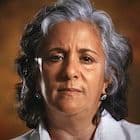
Interviews with Alejandrina García de la Riva
Cuba
Totalitarian Cuba
“In our nation there is nothing. Everything is destroyed. Families do not live in peace.”
Transcript
The regime is very bad. It destroys people. It destroys everything. The brothers Fidel and Raul Castro have been there since 1959. They have committed horrors in our country. They have manipulated all the people or all the people have allowed themselves to be manipulated. It depends how you interpret things. They have destroyed our nation. In our nation there is nothing. Everything is destroyed. Families do not live in peace. The regime wants to have control even over our children and they order them about at the schools on a whim. Parents often disagree but accept it out of fear.
[Fidel Castro (1926 – ) led the Cuban Revolution and seized power in 1959. He established a communist dictatorship in Cuba and led the country until 2008. Raul Castro (1931 – ) is the younger brother of Fidel. He assumed leadership of the Communist Party and the country in 2008.]
It is a regime that has destroyed Cuba. There is nothing in Cuba. We have nothing else but life, the desire to continue living and to fight and the desire for Cuba to be different. We don’t want them [the Castros]. We want good people capable of moving a nation forward. We want our generation, our children, and our grandchildren to live the lives they deserve. But they have destroyed. It is not a government. It is a regime. It is a dictatorship. It is totalitarian. They control everything. They are militants. They militarize everything and they want to do everything. They do not respect people.
They undervalue and underestimate us. They do not think we are capable of doing good so they do not give us opportunities. They run everything.
I want to see a beautiful Cuba. A Cuba where Cubans do not have to leave their country to seek a better life elsewhere. With the right to travel… There are so many Cubans in the world working, developing other nations, creating, working to get ahead. That could happen in our country.
I want to have that freedom in our country. That people have a right to express their feelings without fear. Freedom for other [political] parties to exist, that we can hold elections. That people can truly choose who will govern them, who will run our country. And we will work to make Cuba beautiful with jobs, with freedoms, with good schools for our children. With food, nourishment. Understand? That there is industrial development. I know it existed before 1959.
In Cuba there is much opposition. Many men and women have become members of different movements and organizations. There are many groups and movements in Cuba fighting for true freedom, democracy, for changes in our country. They are found in every Cuban province, from Pinar del Rio to Guantanamo.
About Alejandrina García de la Riva
Alejandrina García de la Riva was born on April 12, 1966, in Matanzas, Cuba. Her first years of life were spent on a sugar mill in the municipality of Calimente. She went to technical school at the Álvaro Reynoso Institute in order to study agriculture and agronomy and held jobs as a statistician, grocer, independent journalist, and a correspondent for Servicio Noticuba, a press agency considered illegal by the Cuban government.
In 1983, Alejandrina married Diosdado González Marrero, a decision that ultimately led her down the path of nonviolent civil resistance. Together the couple has two children and three grandchildren.
In March 2003, Alejandrina’s husband was one of 75 nonviolent dissidents to be arrested in a massive government crackdown known as the Black Spring. He was sentenced to 20 years in prison. In response, Alejandrina and other wives, mothers, and sisters of those imprisoned during the Black Spring founded the Ladies in White [Damas de Blanco].
The Ladies in White became a formidable civil society organization that planned weekly marches through the streets of Havana, peacefully protesting for the freedom of political prisoners and the expansion of civil liberties and political freedoms in Cuba. As a result of her participation, Alejandrina was arrested and harassed by the Cuban authorities on numerous occasions.
Alejandrina played a crucial role in orchestrating the release of her husband and other Black Spring political prisoners. The Ladies in White lobbied Cardinal Jaime Ortega, the leading representative of the Roman Catholic Church in Cuba, and convinced him to negotiate for the release of the prisoners. By 2011, after years of protests and several hunger strikes, the Black Spring dissidents, including Alejandrina’s husband, were released. While the majority of the prisoners went into exile, Alejandrina and Diosdado chose to remain in Cuba.
Alejandrina lives in Mantazas Province and remains active in the Ladies in White Movement.