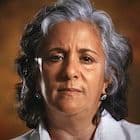
Interviews with Alejandrina García de la Riva
Cuba
Hunger Strike
“I'll go on a hunger strike because something must happen. We must break the ice.”
Transcript
The release of the 75 to Spain and to Chile began. They [those prisoners who agreed to leave Cuba] all left. Those who chose to stay in Cuba were still in prison. There was uncertainty: will they have to serve the remaining years or be freed? That was not specified.
[The Cuban government arrested and imprisoned 75 nonviolent dissidents in March 2003 during a crackdown known as the Black Spring. The Catholic Church, represented by Cardinal Jaime Ortega (1936 – ) the Archbishop of Havana, negotiated the release of the 75 in 2010.]
The Cardinal [Jamie Ortega] did not specify that those who stayed [in Cuba] would also be released. I went to Havana. They said, “Yes, all would be released.” “But when?” “Oh, I don’t know. That step is missing.”
Granma, Cuba´s official newspaper, said that the Prensa Latina [the state news agency] reported that all the prisoners would be released, including those choosing to stay in Cuba.
More days pass and they were not released. They [the Cuban government] had released everyone that wanted out of the country. And those who wanted to stay [in Cuba] remained [in prison]. I went to Havana and said to Laura Pollán, “Laura, something has to happen and I am going on a hunger strike.” Laura said, “Alejandrina, why would you go on a hunger strike?”
[Laura Pollán (1948 – 2011) was one of the founders of the Ladies in White or Damas de Blanco in Spanish. The Ladies in White, a civil society organization founded by the mothers, spouses and daughters of 75 dissidents who were imprisoned by Cuban authorities during the “Black Spring” crackdown in March 2003. They practice nonviolent resistance against the repression of civil liberties on the island of Cuba.]
“I´ll go on a hunger strike because something must happen. We must break that coldness, that ice out there. We do not know whether or not they will be released.” I returned to my province, got a medical checkup. They [doctors] ran some tests on my kidneys, an electrocardiogram. A routine checkup. Everything was fine.
I gave [the results] to my son and said, “Look, it´s all OK. Keep these medical results, because I am going on a hunger strike for your father’s freedom. If something happens [to me], they cannot say that I was sick. Here are all the results. If I have something, it was a lie from the lab in my medical checkup.”
I began my hunger strike on January 28 [2011], José Martí’s date of birth. I had immense support. Laura and Berta [Soler] accompanied me. So many people accompanied me. But there was a wave of repression in my village. People accompanied me night and day. The bishop and priests visited with me, talking, giving me strength…
[Jose Marti (1853 – 1895) is recognized as Cuba’s national hero. Marti was a writer and essayist who advocated for Cuban independence from Spain. Berta Soler (1963 – ) is one of the founders of the Ladies in White]
To our surprise, on the eleventh day of the hunger strike, they began to release prisoners who chose to stay in Cuba: Laura Pollán’s husband [Héctor Maseda Gutiérrez] and Angel Moya Acosta. Well, they released two prisoners.
[Héctor Maseda Gutiérrez (1944 – ) is a Cuban independent journalist who was arrested and sentenced to 20 years in prison during the March 2003 Black Spring crackdown. He was released in 2011. Angel Moya Acosta (1964 – ) is a Cuban pro-democracy activist who was arrested and sentenced to 20 years in prison during the March 2003 Black Spring crackdown. He is married to Ladies in White co-founder Berta Soler and was released from prison in 2011.]
And they [Alejandrina’s supporters] began to say, “Look, you can abandon the strike, it´s a sign.” My husband [Diosdado González Marrero] was also on hunger strike in Combinado of Agüica [a prison in Cuba’s Matanzas province], because they would not budge on their position regarding my husband. He was transferred to another prison- Combinado del Sur, in Matanzas.
[Diosdado González Marrero was one of 75 nonviolent dissidents arrested and imprisoned by the Cuban government during a March 2003 crackdown known as the Black Spring.]
Both my husband and I began hunger strikes. I think that they [the government] were delaying their [prisoners] release, so that they would decide to leave Cuba.
I ended my hunger strike on the eleventh day. I felt very strong. I could have gone on. I was drinking water. It was difficult for me and for my husband. I had never gone on hunger strike.
I know it was not good for a human being. But I felt I could succeed once again as a Lady in White. And something inside me told me, “You have to do it because it is the only way that the agreements between the regime and the [Catholic] Church will be fulfilled”. That´s why I did it.
About Alejandrina García de la Riva
Alejandrina García de la Riva was born on April 12, 1966, in Matanzas, Cuba. Her first years of life were spent on a sugar mill in the municipality of Calimente. She went to technical school at the Álvaro Reynoso Institute in order to study agriculture and agronomy and held jobs as a statistician, grocer, independent journalist, and a correspondent for Servicio Noticuba, a press agency considered illegal by the Cuban government.
In 1983, Alejandrina married Diosdado González Marrero, a decision that ultimately led her down the path of nonviolent civil resistance. Together the couple has two children and three grandchildren.
In March 2003, Alejandrina’s husband was one of 75 nonviolent dissidents to be arrested in a massive government crackdown known as the Black Spring. He was sentenced to 20 years in prison. In response, Alejandrina and other wives, mothers, and sisters of those imprisoned during the Black Spring founded the Ladies in White [Damas de Blanco].
The Ladies in White became a formidable civil society organization that planned weekly marches through the streets of Havana, peacefully protesting for the freedom of political prisoners and the expansion of civil liberties and political freedoms in Cuba. As a result of her participation, Alejandrina was arrested and harassed by the Cuban authorities on numerous occasions.
Alejandrina played a crucial role in orchestrating the release of her husband and other Black Spring political prisoners. The Ladies in White lobbied Cardinal Jaime Ortega, the leading representative of the Roman Catholic Church in Cuba, and convinced him to negotiate for the release of the prisoners. By 2011, after years of protests and several hunger strikes, the Black Spring dissidents, including Alejandrina’s husband, were released. While the majority of the prisoners went into exile, Alejandrina and Diosdado chose to remain in Cuba.
Alejandrina lives in Mantazas Province and remains active in the Ladies in White Movement.