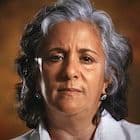
Interviews with Alejandrina García de la Riva
Cuba
Change In Cuba?
“I think everything in Cuba is worse.”
Transcript
In my opinion, I see [reforms to Cuba’s travel policy] as important. Imagine, it was fifty-odd years without any Cuban who opposed the regime being able to leave. Through this opportunity, some people with families [elsewhere in the world] have left Cuba.
[In January 2013, the Cuban regime modified its repressive travel policy allowing some high-profile opposition figures to travel on and off the island. The change also lifted requirements for Cuban citizens to receive exit visas before traveling abroad. A passport and visa from a destination country are now sufficient documentation for travel.]
[Because of this reform] I have personally met with many who helped us in Cuba, given them a hug, exchanged views. I came as a family visitor. I came to see my children. They were determined to leave Cuba and seek refuge. They said, “Dad, if you want to stay in Cuba, we can’t stay. If you will allow us, we will leave.” [“Dad” refers to Ms. Garcia’s husband, former prisoner of conscience Diosdado González Marrero]. It was so.
They are here. Living in this wonderful country with great opportunities. They work without fear. They walk in the streets. My grandchildren also, because I have three grandchildren.
Those of us in Cuba feel we can keep fighting with less fear because they are out of danger.
Travel is good. Many Cuban opposition leaders have traveled. We´re learning. We are experiencing new things and new realities. It’s as if our eyes were covered and we saw nothing, nothing but Cuba. Now I see the development of other countries, how people live.
How there can be so many from so many parts of the world in one nation of different nationalities. How they can walk, get on a bus, work. The streets, good roads, stores. All that I saw in movies, like a dream.
I do not consider that [Cuba’s travel policy reform] to be change. These are rights that we had and they were repressed and violated. Those are rights, not change.
Change is when you can change something for good. That you´re doing what you want but it improves. I think everything in Cuba is worse.
Every day there is more repression. Every day our country is poorer, has less employment. More Cubans want out of our country. The youth do not want to live there and that is sad.
It´s sad for a nation when its children have to leave and want to work to develop other nations, while ours is in shambles.
There is nothing. That that generation, that force, that vigor of so many young people in our country could live in our country with hope and dreams. And that does not happen.
The most important thing to know about Cuba … our reality. The most profound thing about Cuba is the Cuban opposition leaders’ emotions and so many men and women who want to change Cuba. They want Cuba to be free, a democracy. That they know that feeling. That we are fighting for changing our nation.
What we do, we do for love, because we want [freedom]. Simply because we want our country to be like the United States.
About Alejandrina García de la Riva
Alejandrina García de la Riva was born on April 12, 1966, in Matanzas, Cuba. Her first years of life were spent on a sugar mill in the municipality of Calimente. She went to technical school at the Álvaro Reynoso Institute in order to study agriculture and agronomy and held jobs as a statistician, grocer, independent journalist, and a correspondent for Servicio Noticuba, a press agency considered illegal by the Cuban government.
In 1983, Alejandrina married Diosdado González Marrero, a decision that ultimately led her down the path of nonviolent civil resistance. Together the couple has two children and three grandchildren.
In March 2003, Alejandrina’s husband was one of 75 nonviolent dissidents to be arrested in a massive government crackdown known as the Black Spring. He was sentenced to 20 years in prison. In response, Alejandrina and other wives, mothers, and sisters of those imprisoned during the Black Spring founded the Ladies in White [Damas de Blanco].
The Ladies in White became a formidable civil society organization that planned weekly marches through the streets of Havana, peacefully protesting for the freedom of political prisoners and the expansion of civil liberties and political freedoms in Cuba. As a result of her participation, Alejandrina was arrested and harassed by the Cuban authorities on numerous occasions.
Alejandrina played a crucial role in orchestrating the release of her husband and other Black Spring political prisoners. The Ladies in White lobbied Cardinal Jaime Ortega, the leading representative of the Roman Catholic Church in Cuba, and convinced him to negotiate for the release of the prisoners. By 2011, after years of protests and several hunger strikes, the Black Spring dissidents, including Alejandrina’s husband, were released. While the majority of the prisoners went into exile, Alejandrina and Diosdado chose to remain in Cuba.
Alejandrina lives in Mantazas Province and remains active in the Ladies in White Movement.