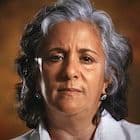
Interviews with Alejandrina García de la Riva
Cuba
Street Journalism
Alejandrina explores the socio-economic challenges of Cubans.
Transcript
My husband’s first prison sentence was in 1999. So, he was imprisoned before 2003. Everything he experienced in prison made my life and my family’s [life] very difficult. And I decided to speak out about it somehow. I searched for a way and I got help. And I started to be a reporter. Or rather I was a correspondent for NotiCuba, an independent group [news agency] in Cuba. That helped me a lot.
I thought “I did not study. I´m not a college graduate. I do not know if I can do it.” But it seemed so easy. I think it´s a calling. It is about the desire to do it and to learn the vocabulary. I did not know many words and it took time for me to learn. I did it because I thought I had to speak out about [what happened to my husband].
I did it until about 2000, 2001. I spent more time taking care of the household. My husband was involved with the opposition and I had to support him more by joining him. Looking to make sure there was no security agent watching, so he could leave the house. And that resulted in me doing less journalism until 2003 when he was imprisoned again.
I did street journalism. I sought interviews from people on the street. How was their day? How is their day that day? What were their problems? If they were willing to tell me, whether they had bread to eat? That was what I did in the community and with the opposition. I spent a lot of time on Elian [Gonzalez] when he was returned to Cuba. I went to the city of Cardenas and there also tried to do something with the Elian Gonzalez story.
[Elian Gonzalez was at the center of a diplomatic crisis between the United States and Cuba in 2000. Gonzalez´s mother drowned while escaping from Cuba to the United States with her son and boyfriend on a raft. The U.S. Immigration and Naturalization Service placed Gonzalez with relatives in Miami who wanted to keep him in the United States against his father´s wishes. A federal court ruled that only Gonzalez´s father could petition for asylum on the boy´s behalf. After the U.S. Supreme Court declined to hear the case, federal agents seized Gonzalez from his relatives and returned him to Cuba.]
I never identified myself as a journalist [to those I interviewed], unless I was recording them.
There is much fear in Cuba. People are afraid that their image or their words will be made public, because they could be punished for it, for telling the truth.
That is also why I had so little work, because many people were afraid and would not allow me to record them.
[NotiCuba] was headed at that time by Angel Pablo Polanco, a freelance journalist. He was responsible for the reports based on our work. [Angel Pablo Polanco is an independent Cuban journalist who has been arrested on multiple occasions because the government feared he would report on opposition protests.]
Our reports were used by Radio and TV Martí, La Poderosa Radio, Radio Mambí. It was mainly for radio.
About Alejandrina García de la Riva
Alejandrina García de la Riva was born on April 12, 1966, in Matanzas, Cuba. Her first years of life were spent on a sugar mill in the municipality of Calimente. She went to technical school at the Álvaro Reynoso Institute in order to study agriculture and agronomy and held jobs as a statistician, grocer, independent journalist, and a correspondent for Servicio Noticuba, a press agency considered illegal by the Cuban government.
In 1983, Alejandrina married Diosdado González Marrero, a decision that ultimately led her down the path of nonviolent civil resistance. Together the couple has two children and three grandchildren.
In March 2003, Alejandrina’s husband was one of 75 nonviolent dissidents to be arrested in a massive government crackdown known as the Black Spring. He was sentenced to 20 years in prison. In response, Alejandrina and other wives, mothers, and sisters of those imprisoned during the Black Spring founded the Ladies in White [Damas de Blanco].
The Ladies in White became a formidable civil society organization that planned weekly marches through the streets of Havana, peacefully protesting for the freedom of political prisoners and the expansion of civil liberties and political freedoms in Cuba. As a result of her participation, Alejandrina was arrested and harassed by the Cuban authorities on numerous occasions.
Alejandrina played a crucial role in orchestrating the release of her husband and other Black Spring political prisoners. The Ladies in White lobbied Cardinal Jaime Ortega, the leading representative of the Roman Catholic Church in Cuba, and convinced him to negotiate for the release of the prisoners. By 2011, after years of protests and several hunger strikes, the Black Spring dissidents, including Alejandrina’s husband, were released. While the majority of the prisoners went into exile, Alejandrina and Diosdado chose to remain in Cuba.
Alejandrina lives in Mantazas Province and remains active in the Ladies in White Movement.