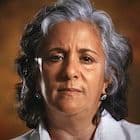
Interviews with Alejandrina García de la Riva
Cuba
The Black Spring
“They even seized my wedding photos so that not even the memory would remain.”
Transcript
In Cuba, spring is the season of change, especially the month of March. On March 18, 19 and 20 of 2003, the regime made a move across the country, a surge of police and state security agents arrived without warning at different homes, in different places, from the cities to the countryside. They attacked families. They took men and their wives as prisoners. [This crackdown is commonly known as the Black Spring.]
They even searched the children in the home. They knocked over everything and took them as prisoners. They condemned them (the trials took place in early April) to sentences of many years: 20 years, 27 years, 28 years, 15 years. The regime claims that they were committing acts against national independence, against Cuban sovereignty.
There are books out there that describe the sentences of these 75 men. They arrested more, but in the end there were 75: 74 men and one woman. It appears that generally they were removed from their homes, and their books, cameras, computers, camcorders, writings, complaints about human rights violations, and writings on the situation of Cuba were seized. The government used those things as evidence to accuse them of acting against Cuban’s sovereignty and independence. I think it’s stupidity. But, that is how they were accused.
That is why they were classified as prisoners of conscience. Because none of them committed any act of violence or bloodshed, or aggression against anyone, neither against the people nor against any member of the regime. All peaceful.
There was a rise in activities within the opposition at that time. The Varela Project had delivered 25,000 signatures and that was too much for the regime. Finding out that 25,000 people said without fear, “I want a referendum”. Then they attacked the opposition leaders to instill more fear in the rest of the opposition.
[The Varela Project was a civil society initiative advocating for free elections and improved human rights in Cuba. It gathered signatures from Cuban citizens in favor of a plebiscite on elections, as permitted by the Cuban constitution. When originally submitted to the government in 2002, the petition contained 11,000 signatures, since that time the number has increased to more than 25,000.]
The prosecution of all those men and one woman was without due process. The families had no opportunity to seek an attorney, to defend their case, what they were facing at the time. And it was very fast. It was only a few days after they were taken to prison and it was very fast. They were detained and taken to a tribunal for prosecution. Days passed and they had no guarantee.
In Cuba, the lawyers work for the regime. They are paid by the regime. Even if one would have paid an attorney to defend him, the lawyer would surely have been visited and told, “No. This is done. He is sentenced to 20 years.” He would defend, pretend to be defending, but it is done.
It doesn’t even mean a thing. But they had no procedural guarantee. It was fast as lightning, as we say in Cuba.
I was arrested that day in my home [during the March 2003 crackdown on dissidents known as Black Spring]. Of all the married couples taken to prison that day, I was the only woman taken to a police station. They put me in a cell until eleven at night.
I did not know what was happening. They put me in a patrol car and left my children alone at home. My children had the door closed. They were told to open the door. My children were afraid. The [police] kicked the door open, tore it apart, and searched [the house while they were home] alone. A 14 year old girl. A 19 year old boy. Anything could have happened. My daughter began to cry. My children became very nervous. Neither mom nor dad was home. They searched everything. They tore up the mattresses, examined everything and took … Do you know what they seized? My wedding photos! From my church wedding.
I think they looked at each of our profiles and knew our strengths and weaknesses. Simply put, I am very family oriented. I´m sentimental. I like family life, my home, my husband, my children, cooking, growing plants. We are Catholics. We are very active within the lay Catholic community in Cuba. Since they knew my profile, they even seized my wedding photos so that not even the memory would remain.
About Alejandrina García de la Riva
Alejandrina García de la Riva was born on April 12, 1966, in Matanzas, Cuba. Her first years of life were spent on a sugar mill in the municipality of Calimente. She went to technical school at the Álvaro Reynoso Institute in order to study agriculture and agronomy and held jobs as a statistician, grocer, independent journalist, and a correspondent for Servicio Noticuba, a press agency considered illegal by the Cuban government.
In 1983, Alejandrina married Diosdado González Marrero, a decision that ultimately led her down the path of nonviolent civil resistance. Together the couple has two children and three grandchildren.
In March 2003, Alejandrina’s husband was one of 75 nonviolent dissidents to be arrested in a massive government crackdown known as the Black Spring. He was sentenced to 20 years in prison. In response, Alejandrina and other wives, mothers, and sisters of those imprisoned during the Black Spring founded the Ladies in White [Damas de Blanco].
The Ladies in White became a formidable civil society organization that planned weekly marches through the streets of Havana, peacefully protesting for the freedom of political prisoners and the expansion of civil liberties and political freedoms in Cuba. As a result of her participation, Alejandrina was arrested and harassed by the Cuban authorities on numerous occasions.
Alejandrina played a crucial role in orchestrating the release of her husband and other Black Spring political prisoners. The Ladies in White lobbied Cardinal Jaime Ortega, the leading representative of the Roman Catholic Church in Cuba, and convinced him to negotiate for the release of the prisoners. By 2011, after years of protests and several hunger strikes, the Black Spring dissidents, including Alejandrina’s husband, were released. While the majority of the prisoners went into exile, Alejandrina and Diosdado chose to remain in Cuba.
Alejandrina lives in Mantazas Province and remains active in the Ladies in White Movement.