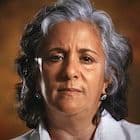
Interviews with Alejandrina García de la Riva
Cuba
John Paul II in Cuba
“The visit of His Holiness John Paul II at that time was scary for the regime.”
Transcript
The churches in Cuba – all churches – but I speak specifically of the Catholic Church, are impartial. I assure you of that, because I am a member. It is impartial.
It is a church open to the humble, to the people. A church that offers messages about Cuba’s reality, Cubans’ lives, and how to find spiritual relief and strength. It´s what encourages the people.
But the church in Cuba is also repressed by the regime, even if it has nothing to do with the regime, because it is an independent institution. [The regime] fears it.
The priests are threatened by State Security agents and told: “Why do you allow those people in the church?” Then they hear: “The church is open to all people, for the poor, the highest, the military, anyone who wants to enter.”
They are afraid. I assure you that they are afraid.
[Pope] John Paul II’s message was inspiring. A message of life. A message of courage for Cubans. A message that we had not even heard from our priests, saying, “Be a leader yourself, do not be afraid.” [Pope John Paul II (1920 – 2005) was born Karol Wotyla in Poland. He became a priest in the Roman Catholic Church and after becoming Archbishop of Krakow, was named the first Polish pope in 1978. Pope John Paul II made a historic visit to Cuba in January 1998. During an open-air mass in Santiago, John Paul II delivered a message to the tens of thousands gathered endorsing political freedom and civil liberty. It was the first visit to the island by a pope.]
That public message in a packed square was very good for Cubans and for the Cuban church, too.
The visit of His Holiness John Paul [II] at that time was also a scary visit for the regime. They were afraid of what might happen. There were large groups headed toward the squares that they could not control very well. They were afraid. They arrested many. They did not allow us to go to the squares to participate in John Paul’s [II] masses and hear his homilies.
My husband and I experienced that same aggression from the regime. The bus in which we travelled with other members of our Catholic Church of Saint Catherine of Siena, from Perico, Matanzas, was turned away as we neared the square.
They did that because the State Security had called our priest and told him not to allow us to go to the mass at the José Martí Square in Havana. He was told to kick us off the bus. The priest refused and said that we had the same right to attend.
Then to cause annoyance and to turn us against each other, so that our congregation felt that they had been harassed and repressed due to our cause, no one on the bus was allowed to participate. So, it was a difficult encounter, set in motion by the State Security because we were members of the opposition.
Those messages given by His Holiness at that time, John Paul II, were well taken by Cubans. I think since then, since 1998, more movements have emerged, more people and groups decided to speak publicly about the regime. To denounce the condemnations and now even the lay Catholic Church [decided] to express itself more freely without fear. And to welcome more people, from the opposition or dissent.
About Alejandrina García de la Riva
Alejandrina García de la Riva was born on April 12, 1966, in Matanzas, Cuba. Her first years of life were spent on a sugar mill in the municipality of Calimente. She went to technical school at the Álvaro Reynoso Institute in order to study agriculture and agronomy and held jobs as a statistician, grocer, independent journalist, and a correspondent for Servicio Noticuba, a press agency considered illegal by the Cuban government.
In 1983, Alejandrina married Diosdado González Marrero, a decision that ultimately led her down the path of nonviolent civil resistance. Together the couple has two children and three grandchildren.
In March 2003, Alejandrina’s husband was one of 75 nonviolent dissidents to be arrested in a massive government crackdown known as the Black Spring. He was sentenced to 20 years in prison. In response, Alejandrina and other wives, mothers, and sisters of those imprisoned during the Black Spring founded the Ladies in White [Damas de Blanco].
The Ladies in White became a formidable civil society organization that planned weekly marches through the streets of Havana, peacefully protesting for the freedom of political prisoners and the expansion of civil liberties and political freedoms in Cuba. As a result of her participation, Alejandrina was arrested and harassed by the Cuban authorities on numerous occasions.
Alejandrina played a crucial role in orchestrating the release of her husband and other Black Spring political prisoners. The Ladies in White lobbied Cardinal Jaime Ortega, the leading representative of the Roman Catholic Church in Cuba, and convinced him to negotiate for the release of the prisoners. By 2011, after years of protests and several hunger strikes, the Black Spring dissidents, including Alejandrina’s husband, were released. While the majority of the prisoners went into exile, Alejandrina and Diosdado chose to remain in Cuba.
Alejandrina lives in Mantazas Province and remains active in the Ladies in White Movement.