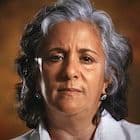
Interviews with Alejandrina García de la Riva
Cuba
Background
Alejandrina discusses her background.
Transcript
My name is Alejandrina García de la Riva.
I was born in Cuba in the province of Matanzas on April 12, 1966 at the “August 6th” Sugar Mill. I grew up there. They were my first years of life. My parents were humble people.
My mother was a housewife. My father was an ambulance driver. I earned an Associate Degree in General Agriculture. Agronomy is my specialty. [Agronomy is the science and technology of producing and using plants for food, fuel, fiber, and reclamation.]
I had several jobs in my youth, even though I also had children at a young age. I worked as a cane cutter, hand-cutting sugarcane. I worked in the office. I was a statistician. I computed the amount of cane they cut.
I also worked in dining halls where they [sugar cane cutters] lived. I was the cane cutters’ storekeeper. I was responsible for taking out the food that was to be prepared for them.
Those were my jobs. Then I became a housewife for a while. In 1994, I learned that my husband belonged to the opposition in Cuba. He worked and continues to work in human rights. But back then, I was very afraid and stopped working for the government. So before they fired me, I stopped working and became a housewife.
My husband’s name is Diosdado González Marrero.
We have been married 30 years. We married in 1983 and I had my first child, a son, in 1984. And in 1988, I had a daughter. We have two children.
When I was very young, I didn’t understand what we were experiencing. But after starting my family, I started to understand. [We experienced] shortages in the home. My husband explained that he did what he did because of human rights violations in Cuba, and then I began to look at the environment in which I lived and I realized that it was wrong. I started working in journalism. That’s why I was a reporter for NotiCuba, an independent news agency in Cuba.
And that helped me to have a little more experience of how to do something each day to make others aware of the reality of my country. How human rights are violated. How there is so much misery, so much inequality. How there are corrupt people are running the country in a bad way. Supporting my husband was the final decision. Supporting him in all the work he was doing. Even though I was scared, I supported him.
About Alejandrina García de la Riva
Alejandrina García de la Riva was born on April 12, 1966, in Matanzas, Cuba. Her first years of life were spent on a sugar mill in the municipality of Calimente. She went to technical school at the Álvaro Reynoso Institute in order to study agriculture and agronomy and held jobs as a statistician, grocer, independent journalist, and a correspondent for Servicio Noticuba, a press agency considered illegal by the Cuban government.
In 1983, Alejandrina married Diosdado González Marrero, a decision that ultimately led her down the path of nonviolent civil resistance. Together the couple has two children and three grandchildren.
In March 2003, Alejandrina’s husband was one of 75 nonviolent dissidents to be arrested in a massive government crackdown known as the Black Spring. He was sentenced to 20 years in prison. In response, Alejandrina and other wives, mothers, and sisters of those imprisoned during the Black Spring founded the Ladies in White [Damas de Blanco].
The Ladies in White became a formidable civil society organization that planned weekly marches through the streets of Havana, peacefully protesting for the freedom of political prisoners and the expansion of civil liberties and political freedoms in Cuba. As a result of her participation, Alejandrina was arrested and harassed by the Cuban authorities on numerous occasions.
Alejandrina played a crucial role in orchestrating the release of her husband and other Black Spring political prisoners. The Ladies in White lobbied Cardinal Jaime Ortega, the leading representative of the Roman Catholic Church in Cuba, and convinced him to negotiate for the release of the prisoners. By 2011, after years of protests and several hunger strikes, the Black Spring dissidents, including Alejandrina’s husband, were released. While the majority of the prisoners went into exile, Alejandrina and Diosdado chose to remain in Cuba.
Alejandrina lives in Mantazas Province and remains active in the Ladies in White Movement.