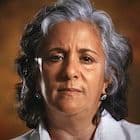
Interviews with Alejandrina García de la Riva
Cuba
Married to a Political Prisoner
“I will not leave until I see your father.”
Transcript
To our surprise, my husband [Diosdado González Marrero] was transferred to the Agüica prison. It is a notorious prison in the Matanzas province where prisoners undergo so much torture. The prison also has certain characteristics … All prisoners must wear a uniform.
[Diosdado González Marrero was one of 75 nonviolent dissidents arrested and imprisoned by the Cuban government during a March 2003 crackdown known as the Black Spring.]
When the military comes by for inspection they [the prisoners] must stand at attention and salute. In a sense, [they must] show respect. And my husband, while in prison, never submitted to it nor did he wear the uniform. As they passed by for inspection he did not assume the stance. He said: “I am in prison. You know I am here and I will not stand.”
When he was taken to Agüica, he grew a beard in protest, like a political prisoner. When he arrived at the prison they wanted to shave it off by force. They wanted to force him to wear the uniform.
I found out because I had a phone conversation with him when he was transferred. I went to the prison with my son and I asked to see my husband and they told me no.
I was told I could not see him because my husband would not wear the prison clothes or do what they asked. I could not see him. I figured I was not allowed to see my husband because my husband was on a hunger strike in protest because he was transferred, but the conditions [in Agüica] were harsher.
I told the prison authorities, I´m not leaving here until I see my husband. “Very well,” they said “but you will do so in front of the property.” I replied, “Don’t worry; I know where I can stand.” Then I told my son, “Go to the house, bring me supplies, an umbrella, towels, water. I´m going to stand here on a hunger strike. I will not leave until I see your father.”
I began to communicate with some people, opponents from the city of Colón and they went there to support me. They began to call the radio stations, the mass media, exile communications, Radio Martí.
About 21 department officials, senior officers of Cuban State Security from Villa Marista [prison] arrived at dawn to talk with me outside of the prison. Opposition activists accompanied me.
I was determined not to eat. I said, “No. This is a difficult situation that you have created. I want to see my husband.” State Security officer Samper said, “Alejandrina, everything will be resolved”.
I said, “But I do not know when. Meanwhile my husband is in worse conditions inside. It cannot be. I will stay. You go in and resolve the problem inside. I´m not leaving until I see my husband.”
It was the next day at noon. They allowed me to see my husband. Actually that strike did not last long. I was able to see my husband.
About Alejandrina García de la Riva
Alejandrina García de la Riva was born on April 12, 1966, in Matanzas, Cuba. Her first years of life were spent on a sugar mill in the municipality of Calimente. She went to technical school at the Álvaro Reynoso Institute in order to study agriculture and agronomy and held jobs as a statistician, grocer, independent journalist, and a correspondent for Servicio Noticuba, a press agency considered illegal by the Cuban government.
In 1983, Alejandrina married Diosdado González Marrero, a decision that ultimately led her down the path of nonviolent civil resistance. Together the couple has two children and three grandchildren.
In March 2003, Alejandrina’s husband was one of 75 nonviolent dissidents to be arrested in a massive government crackdown known as the Black Spring. He was sentenced to 20 years in prison. In response, Alejandrina and other wives, mothers, and sisters of those imprisoned during the Black Spring founded the Ladies in White [Damas de Blanco].
The Ladies in White became a formidable civil society organization that planned weekly marches through the streets of Havana, peacefully protesting for the freedom of political prisoners and the expansion of civil liberties and political freedoms in Cuba. As a result of her participation, Alejandrina was arrested and harassed by the Cuban authorities on numerous occasions.
Alejandrina played a crucial role in orchestrating the release of her husband and other Black Spring political prisoners. The Ladies in White lobbied Cardinal Jaime Ortega, the leading representative of the Roman Catholic Church in Cuba, and convinced him to negotiate for the release of the prisoners. By 2011, after years of protests and several hunger strikes, the Black Spring dissidents, including Alejandrina’s husband, were released. While the majority of the prisoners went into exile, Alejandrina and Diosdado chose to remain in Cuba.
Alejandrina lives in Mantazas Province and remains active in the Ladies in White Movement.