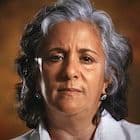
Interviews with Alejandrina García de la Riva
Cuba
Challenges for the Opposition
“There is repression every day.”
Transcript
People find, perhaps, within those movements or those opposition parties or organizations, in which they become members, characteristics of their own personality, according to what they prefer.
There are civic protest, civil disobedience groups in the streets. There are unity groups, such as UNPACU [Union Patriotica de Cuba] now operating. There is a women’s movement, the Ladies in White [or Damas de Blanco in Spanish] of which I am a member.
[The Union Patriotica de Cuba or Patriotic Union of Cuba is a civil society organization founded in 2011. Its mission is uniting the Cuban opposition and advocating for nonviolent struggle against the repression of civil liberties on the island of Cuba. The Ladies in White is a civil society organization founded by the mothers, spouses and daughters of dissidents who were imprisoned by Cuban authorities during the Black Spring crackdown in March 2003. They practice nonviolent resistance against the repression of civil liberties on the island of Cuba.]
And all of them, in some way, have the same intent. The fact that their projects and work are not in line with the others, well, that is perhaps due to us being less prepared in political matters. We also have much to learn about that.
But I do say that it is good that there’s an opposition. That is how I know that the opposition is spreading knowledge about Cuba to other parts of the world.
The fundamental challenge… I do not know much about politics, however, I think the fundamental challenge is to be recognized by the people to gain their support. That people see that what we do is for the benefit of all. And that they believe that we want our country to change. That´s the challenge: recognition by all of Cuba. That they trust what we do and also join us if they want.
All these organizations face the daily risk that their members might be punished. Every day in Cuba there are beatings, arrests, and short and long-term detentions inside prisons. Even without being taken to a court of law and prosecuted for a crime, many opposition members remain in prisons without [being charged for] a crime. Without being convicted. Every day there is repression: the surveillance by national security and their attempts to destroy and divide the organizations to the extent they can.
We do not know what to expect. When we leave our home, the regime organizes mobs. They are called Rapid Response Brigades. They are prepared, organized and financed by the regime to attack us and prevent us from getting to the churches.
[A typical Ladies in White protest involves attending Catholic Mass each Sunday and conducting peaceful street marches afterward.]
Even when we arrive at the churches they arrest us, attack us, hit us. Those are the big risks. There is also a risk of sickness, from the stress. My hair has fallen out; my hair has abruptly turned gray. It is because of what I am living through.
Many families may not accept what you do because they are afraid, so they stop meeting with you. Sometimes neighbors are also afraid. It’s like one runs the risk at times, though it’s not generally the case, but there are many who run the risk of being alone because of fear.
The fundamental risk is prison, the physical and psychological torture. The illnesses that we experience because of what we endure.
About Alejandrina García de la Riva
Alejandrina García de la Riva was born on April 12, 1966, in Matanzas, Cuba. Her first years of life were spent on a sugar mill in the municipality of Calimente. She went to technical school at the Álvaro Reynoso Institute in order to study agriculture and agronomy and held jobs as a statistician, grocer, independent journalist, and a correspondent for Servicio Noticuba, a press agency considered illegal by the Cuban government.
In 1983, Alejandrina married Diosdado González Marrero, a decision that ultimately led her down the path of nonviolent civil resistance. Together the couple has two children and three grandchildren.
In March 2003, Alejandrina’s husband was one of 75 nonviolent dissidents to be arrested in a massive government crackdown known as the Black Spring. He was sentenced to 20 years in prison. In response, Alejandrina and other wives, mothers, and sisters of those imprisoned during the Black Spring founded the Ladies in White [Damas de Blanco].
The Ladies in White became a formidable civil society organization that planned weekly marches through the streets of Havana, peacefully protesting for the freedom of political prisoners and the expansion of civil liberties and political freedoms in Cuba. As a result of her participation, Alejandrina was arrested and harassed by the Cuban authorities on numerous occasions.
Alejandrina played a crucial role in orchestrating the release of her husband and other Black Spring political prisoners. The Ladies in White lobbied Cardinal Jaime Ortega, the leading representative of the Roman Catholic Church in Cuba, and convinced him to negotiate for the release of the prisoners. By 2011, after years of protests and several hunger strikes, the Black Spring dissidents, including Alejandrina’s husband, were released. While the majority of the prisoners went into exile, Alejandrina and Diosdado chose to remain in Cuba.
Alejandrina lives in Mantazas Province and remains active in the Ladies in White Movement.