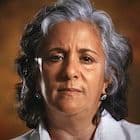
Interviews with Alejandrina García de la Riva
Cuba
Inequality In Cuba
“Milk is scarce, there is no meat, soap is scarce, oil is scarce.”
Transcript
Inequality. In Cuba there is inequality. In Cuba, not all people are equal. There are the leaders of the regime. These are people whose homes, whose way of life are very different.
Inequality in Cuba means that we do not all live in the same way. In Cuba, there are visible differences between the classes. The regime leaders, those who are Communist Party members, live a better life.
You see it in their lives, their homes, their clothing.
It’s as if they do not speak very much with others and they think they are better than anybody else, and in fact, they have an air of superiority.
There are also those who work in tourism, in hotels. These people are chosen – young people that must be members of Cuba´s Communist Party. Their way of life is also different from people in the country: a farmer, a worker in an industry, in a factory. There is a big difference. There are very poor people in Cuba.
Yes, there are many differences. In the privileges and quality of life. It is visible.
In Cuba, a typical Cuban is one who is visibly unhappy, who faces challenges, who has problems. You see in his appearance that he faces many challenges, especially economic, political. It is obvious that he is having a hard time.
In fact, it is even hard for a Cuban to sleep and when he wakes his first thought is, “How am I going to get money or food to support my family, my children?” Milk is scarce, there is no meat, soap is scarce, oil is scarce. A family’s basic needs.
Women also have to work, even working in the fields, lots of hard work under the sun. It is not dishonorable, but it is not good for a woman who does not eat, who does not even have the most basic hygiene at home. And that is the life of a Cuban. He thinks, “How will I live today and how I will make it work tomorrow?”
Yes, in Havana people live differently than those in the country but it is not … How do I explain? It’s not that the problems are different. There are problems in Havana and in all of Cuba. But in Havana, the capital, there are more means of transport. The markets have more products, although the prices are very high. In the country, it is harder. Transportation, even work, right? It is harder to have a job in the country than in the city.
About Alejandrina García de la Riva
Alejandrina García de la Riva was born on April 12, 1966, in Matanzas, Cuba. Her first years of life were spent on a sugar mill in the municipality of Calimente. She went to technical school at the Álvaro Reynoso Institute in order to study agriculture and agronomy and held jobs as a statistician, grocer, independent journalist, and a correspondent for Servicio Noticuba, a press agency considered illegal by the Cuban government.
In 1983, Alejandrina married Diosdado González Marrero, a decision that ultimately led her down the path of nonviolent civil resistance. Together the couple has two children and three grandchildren.
In March 2003, Alejandrina’s husband was one of 75 nonviolent dissidents to be arrested in a massive government crackdown known as the Black Spring. He was sentenced to 20 years in prison. In response, Alejandrina and other wives, mothers, and sisters of those imprisoned during the Black Spring founded the Ladies in White [Damas de Blanco].
The Ladies in White became a formidable civil society organization that planned weekly marches through the streets of Havana, peacefully protesting for the freedom of political prisoners and the expansion of civil liberties and political freedoms in Cuba. As a result of her participation, Alejandrina was arrested and harassed by the Cuban authorities on numerous occasions.
Alejandrina played a crucial role in orchestrating the release of her husband and other Black Spring political prisoners. The Ladies in White lobbied Cardinal Jaime Ortega, the leading representative of the Roman Catholic Church in Cuba, and convinced him to negotiate for the release of the prisoners. By 2011, after years of protests and several hunger strikes, the Black Spring dissidents, including Alejandrina’s husband, were released. While the majority of the prisoners went into exile, Alejandrina and Diosdado chose to remain in Cuba.
Alejandrina lives in Mantazas Province and remains active in the Ladies in White Movement.