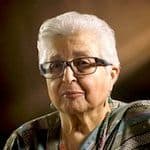
Interviews with Frene Ginwala
South Africa
Public Relations
“We had more offices than the South African government had embassies.”
Transcript
Well, firstly, we already, by then had broadcasting facilities from a number of African countries. Used to broadcast from Angola, from – as African countries near South Africa became independent, they would give us broadcasting facilities. So we were already broadcasting that way. The anti-apartheid movement, the African countries set up the equivalent of anti-apartheid movements. And it was now a global phenomenon. But London became one of the major places because you had a lot of international journalists there, radio stations and so on. So we were producing illegal material for inside the country [South Africa].
Some of it was produced in other African countries, but it was the major channel and had to be got into the country. We were also broadcasting from these stations. Major statements were coming out through London because of its facilities. At that time, initially there was tremendous concern that only Lusaka [Zambia] could speak, and we tried to explain that it wouldn’t work because coming out of Lusaka would take time, and you had to react immediately. So a committee was set up in London. We had Mendi Msimang as the chief representative. He became our first high commissioner after ’94. And I suppose he had the trust in some of us to agree that we could speak without waiting for Lusaka.
[Lusaka, Zambia became the location of the African National Congress’ headquarters after being banned in South Africa.]
Oliver Tambo had a lot to do with that as well. And so, for example, when – well, we got into the British media. We got into the international media. They knew they could come to us to ask us. Very often when journalists were going back to South Africa, they would see us, or were going to be based in South Africa, they would meet with the London group, media group, and we would put them in touch with people or brief them and say, “If you speak to so-and-so, this -” so we also had to trust and build up a group of international journalists whom we could trust to speak to somebody at home and who would report accurately. So this was the sort of thing.
[Oliver Tambo (1917 – 1993) was an anti-apartheid activist and a senior leader of the African National Congress (ANC). He served as the organization’s president from 1967 – 1991 and kept the ANC together from exile after it was banned by the South African government in 1960.]
But we’d reached a stage when we got a lot of information out of South Africa. For example, I was the head of research, and we were monitoring very closely what was going on.
One way or another, we used to get publications in [to South Africa]. We used to, for example, a lot of stickers that would appear had been actually produced overseas. The anti-apartheid movements, for example, the Dutch anti-apartheid movement, was putting leaflets into goods that were being exported to South Africa on the idea that, when people would unpack them would obviously be Africans, and so this would distribute. So all of this was being done through different – we had offices – we had more offices than the South African government had embassies at the time we were unbanned.
About Frene Ginwala
Frene Ginwala was born in 1932 in Johannesburg. A South African of Indian descent, Ginwala was keenly aware of the role race played in South African society. She studied law at the University of London and then returned to South Africa.
As political tensions rose between the white minority government and non-whites, Ginwala joined the African National Congress (ANC), the country’s main opposition group to the apartheid government. Following the 1960 Sharpeville Massacre, during which police shot at thousands of demonstrators protesting travel restrictions for non-whites, the government banned the ANC. Ginwala was tasked with coordinating the escape of senior ANC leader Oliver Tambo to Tanzania and establishing the organization’s external mission. She wouldn’t return to South Africa for thirty years.
During her exile, Ginwala headed the Political Research Unit in the Office of ANC President Oliver Tambo. She also served as the ANC spokesperson in the United Kingdom, often addressing matters on sanctions against South Africa’s apartheid government.
In 1990, President F.W. de Klerk’s government lifted the ANC ban and Ginwala returned to South Africa. Prior to the country’s first democratic elections in 1994, she helped set up the Women’s National Coalition, which gathered organizations from across the political spectrum to ensure women’s common interests were reflected in South Africa’s post-apartheid constitution. Ginwala was elected to parliament in 1994 where she served as Speaker of the National Assembly until 2004. As the first post-apartheid speaker, she was instrumental in setting a new course for the government, promoting an atmosphere of cooperation and reconciliation.
Since leaving government, Ginwala served as the First Chancellor of one of South Africa’s flagship universities, The University of Kwazula-Natal, until 2009. She has continued promoting democracy, good governance, development and human rights through her participation with various international organizations such as the United Nations and the International Institute for Democracy and Electoral Assistance.