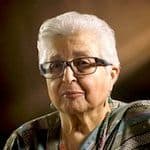
Interviews with Frene Ginwala
South Africa
Election Day
“For the first time we were voting for somebody.”
Transcript
Well, even before that, the excitement, for most of us, we’d never voted before [1994]. So – but it was more the significance of – for the first time we were voting for somebody. That was very important. We had massive election campaigns, posters, we were going around the country talking about elections. We found suddenly that people were being told that you mustn’t put a cross on the ballot paper. You just put a tick. Cross means you didn’t, but in fact, you had to put a cross, you see, so we were also then trying to counter that kind of publicity.
We were trying to ensure that at particularly the farm workers, they should be allowed to vote, so you had to go politically and talk to the farm owners and so on and say people should be allowed. The independent electoral commission was doing that, but we as ANC [African National Congress], people were being deployed to go to this community, to go there, speak to them, reassure them about the ANC, because for a lot of people it was strange. And so it was – apart from the general buzz, it was that kind of thing, working out what should we be doing, and so on and countering anything that was happening.
[South Africa’s first democratic, non-racial parliamentary elections occurred in 1994. Nelson Mandela was unanimously elected by the new parliament as the first post-apartheid president. The ANC is a political party that served as the most prominent resistance movement against South Africa’s apartheid system, at times resorting to violence through its military wing, Umkhonto we Sizwe. It was officially banned by the South African government from 1960 to 1990. As apartheid collapsed, the ANC’s leader, Nelson Mandela, was elected President of South Africa in 1994 and established a democratic government.]
Most of us voted two or three days before because we knew we had to be monitoring the voting stations on the day, so we voted two or three days before. It was, you know, quite something. I kept looking at the paper.
Did I put the right cross? But it was – and most all of us were feeling this because when we were talking before and after, we saw this. And then, on Election Day itself, and it was more than one day, you would go there early in the morning to whichever stations you were monitoring, checking with their ballot papers, was everything okay, what was happening, talking to people in the queue. We were not allowed to campaign in the precincts of the election, but the queues were way outside, and reassuring them.
About Frene Ginwala
Frene Ginwala was born in 1932 in Johannesburg. A South African of Indian descent, Ginwala was keenly aware of the role race played in South African society. She studied law at the University of London and then returned to South Africa.
As political tensions rose between the white minority government and non-whites, Ginwala joined the African National Congress (ANC), the country’s main opposition group to the apartheid government. Following the 1960 Sharpeville Massacre, during which police shot at thousands of demonstrators protesting travel restrictions for non-whites, the government banned the ANC. Ginwala was tasked with coordinating the escape of senior ANC leader Oliver Tambo to Tanzania and establishing the organization’s external mission. She wouldn’t return to South Africa for thirty years.
During her exile, Ginwala headed the Political Research Unit in the Office of ANC President Oliver Tambo. She also served as the ANC spokesperson in the United Kingdom, often addressing matters on sanctions against South Africa’s apartheid government.
In 1990, President F.W. de Klerk’s government lifted the ANC ban and Ginwala returned to South Africa. Prior to the country’s first democratic elections in 1994, she helped set up the Women’s National Coalition, which gathered organizations from across the political spectrum to ensure women’s common interests were reflected in South Africa’s post-apartheid constitution. Ginwala was elected to parliament in 1994 where she served as Speaker of the National Assembly until 2004. As the first post-apartheid speaker, she was instrumental in setting a new course for the government, promoting an atmosphere of cooperation and reconciliation.
Since leaving government, Ginwala served as the First Chancellor of one of South Africa’s flagship universities, The University of Kwazula-Natal, until 2009. She has continued promoting democracy, good governance, development and human rights through her participation with various international organizations such as the United Nations and the International Institute for Democracy and Electoral Assistance.