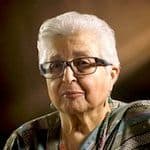
Interviews with Frene Ginwala
South Africa
Mandela's Release
Frene Ginwala remembers predicting Nelson Mandela’s release from prison.
Transcript
We knew, for example, that Mandela was going to be released. We didn’t know the date, but by then, the international climate was such we had already got the arms embargo through the Security Council, and when the – we knew when Mandela had been moved, that they were trying to make contact with him.
Also, I suppose Oliver Tambo knew much more about those contacts than any of us, but from his briefings. We knew, for example, because other people had informed me that I kept touch with the financial markets. That was extremely important. Where South Africa was selling gold, the problems they were having, the debt crisis they were in, and the pressure was going to come in the early part of February 1990.
[Nelson Mandela (1918 – 2013) was a South African anti-apartheid revolutionary and politician who served as the first post-apartheid President of South Africa from 1994-1999. Mandela was arrested and tried in1962. He was accused on two counts: inciting persons to strike illegally and leaving the country without a valid passport. Mandela was found guilty and sentenced to five years in prison. In 1963, while still serving his sentence, Mandela was put on trial again and sentenced to life in prison. From 1977 – 1994, the United Nations Security Council imposed an arms embargo on South Africa. Oliver Tambo (1917 – 1993) was an anti-apartheid activist and a senior leader of the African National Congress (ANC). He served as the organization’s president from 1967 – 1991 and kept the ANC together from exile after it was banned by the South African government in 1960.]
So I, through internal links again with journalists, and the fact that South Africa was having a big international investment conference in South Africa, we reported back to Lusaka [Zambia] chances are that the beginning of February, they will unban, because they had told the international investors, “No, no, please come. Please come. Something’s going to happen.” Could only be the release of Mandela that would have changed any international climate. And we were believed. I think this was the important thing. You had to have that kind of trust. So I had arranged for somebody in South Africa to fax me the statement that de Klerk was going to speak. They stopped it.
[Frederick Willem de Klerk (1936 – ) served as President of South Africa from 1989 – 1994. Lusaka, Zambia became the location of the African National Congress’ headquarters after being banned in South Africa. Under de Klerk’s leadership the apartheid system was dismantled, the ANC’s 30 year ban ended, political prisoners were released and majority (multiracial) elections were established.]
But this person was really good. Whatever means he used, I don’t know, but I got the statement and I was able to warn the ANC [African National Congress], both in Lusaka and in London. So early that morning, we had a meeting in the office of the Chief Representative [of the ANC London branch]. The person who didn’t come was when I said the Communist Party was going to be unbanned and MK [Umkhonto we Sizwe], the military wing, was going to be unbanned. And the representative heard this, “Tell Frene she’s mad. I’m not coming to any meeting.” So they missed out, but this is exactly what happened. The statement had those things.
[The ANC is a political party that served as the most prominent resistance movement against South Africa’s apartheid system, at times resorting to violence through its military wing, Umkhonto we Sizwe. It was officially banned by the South African government from 1960 to 1990. As apartheid collapsed, the ANC’s leader, Nelson Mandela, was elected President of South Africa in 1994 and established a democratic government.]
The date of the release of Mandela, I had suggested, and my research people, because I had a whole research network, had to be before the investment conference if it was going to have any meaning. So when Mandela was not released on the day that de Klerk made his speech, it had to be the following weekend, which in fact it was.
About Frene Ginwala
Frene Ginwala was born in 1932 in Johannesburg. A South African of Indian descent, Ginwala was keenly aware of the role race played in South African society. She studied law at the University of London and then returned to South Africa.
As political tensions rose between the white minority government and non-whites, Ginwala joined the African National Congress (ANC), the country’s main opposition group to the apartheid government. Following the 1960 Sharpeville Massacre, during which police shot at thousands of demonstrators protesting travel restrictions for non-whites, the government banned the ANC. Ginwala was tasked with coordinating the escape of senior ANC leader Oliver Tambo to Tanzania and establishing the organization’s external mission. She wouldn’t return to South Africa for thirty years.
During her exile, Ginwala headed the Political Research Unit in the Office of ANC President Oliver Tambo. She also served as the ANC spokesperson in the United Kingdom, often addressing matters on sanctions against South Africa’s apartheid government.
In 1990, President F.W. de Klerk’s government lifted the ANC ban and Ginwala returned to South Africa. Prior to the country’s first democratic elections in 1994, she helped set up the Women’s National Coalition, which gathered organizations from across the political spectrum to ensure women’s common interests were reflected in South Africa’s post-apartheid constitution. Ginwala was elected to parliament in 1994 where she served as Speaker of the National Assembly until 2004. As the first post-apartheid speaker, she was instrumental in setting a new course for the government, promoting an atmosphere of cooperation and reconciliation.
Since leaving government, Ginwala served as the First Chancellor of one of South Africa’s flagship universities, The University of Kwazula-Natal, until 2009. She has continued promoting democracy, good governance, development and human rights through her participation with various international organizations such as the United Nations and the International Institute for Democracy and Electoral Assistance.