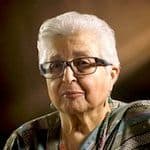
Interviews with Frene Ginwala
South Africa
Legal Discrimination
“It was said openly there is no place for the African in white society.”
Transcript
The pass laws were laws which control the – originally of all – just African males. Then they tried to extend them to African women, and the women put up a tremendous resistance, so they never succeeded in totally putting those restrictions. You could not be on the streets after 6:00 in the evening without a pass. You couldn’t move from one province to another without a pass. It was a thing for a permit, and you couldn’t live in a particular place without permit or pass that would allow you to live there, so these laws were there to control the movement of the African population. For Indians, you couldn’t go from one province to another without a permit. They didn’t call them a pass, but they called it a permit. So these were laws that controlled the freedom of movement of the black population generally.
You see, when the Nationalist Party came to power in 1948, they started tightening up on every aspect of people’s lives. What they started doing, they banned people, for example, a journalist could be banned, which meant they could not publish, could not even enter a newspaper office. Could have no contact with a whole range of people. It was also, in many cases, a form of house arrest. People were also banished. That means they were no longer allowed to be in the urban areas, and they moved all these people to go into various rural areas. Those affected, initially, only the African population, but subsequently, it affected all blacks, and it started affecting whites. White journalists were also banned. They couldn’t carry out their profession.Lawyers were banned. Indian population, similarly, was restricted. So these laws were there slowly imposing more and more restrictions.
[The National Party, founded in 1914, ruled South Africa from 1948 to 1994. Its following included mostly Dutch-descended Afrikaners and English-speaking whites. The National Party was long dedicated to policies of apartheid and white supremacy. By the early 1990s, the party had moved toward sharing power with South Africa’s black majority. Banning was a legal process during apartheid enabled primarily by the Suppression of Communism Act, which prohibited individuals from communicating with more than one person at a time and from traveling domestically or internationally without permission. Organizations were also banned by the government. The media was restricted in covering banned individuals.]
Then Bantu education was introduced, in which it was said openly there is no place for the African in white society. So it meant you had to have a restricted education. You could not learn things. You couldn’t do research.
[The Bantu Education Act authorized the system of education that the South African apartheid government implemented as part of its general policy of separation and stratification of the races.]
You were not taught things. Apart from the fact that they used Afrikaans as a language, but it was also the syllabus was totally controlled. So these restrictions started coming in from 1948 gradually, and individual leaders were either banned or banished. If you were just banned, you couldn’t attend meetings, you couldn’t go into certain places. Well-known journalist Ruth First was subsequently assassinated in Mozambique. She was an internationally-known journalist, but she was – they were banned then imprisoned for 90 days, but as you walked out after the 90 days, you were served with another banning order, so now it became 180 days and so on. This applied with no racial restrictions. Everybody was subject to these laws.
[Ruth First (1925 – 1982) was an anti-apartheid activist, journalist and scholar who was assassinated via a letter bomb while in exile.]
About Frene Ginwala
Frene Ginwala was born in 1932 in Johannesburg. A South African of Indian descent, Ginwala was keenly aware of the role race played in South African society. She studied law at the University of London and then returned to South Africa.
As political tensions rose between the white minority government and non-whites, Ginwala joined the African National Congress (ANC), the country’s main opposition group to the apartheid government. Following the 1960 Sharpeville Massacre, during which police shot at thousands of demonstrators protesting travel restrictions for non-whites, the government banned the ANC. Ginwala was tasked with coordinating the escape of senior ANC leader Oliver Tambo to Tanzania and establishing the organization’s external mission. She wouldn’t return to South Africa for thirty years.
During her exile, Ginwala headed the Political Research Unit in the Office of ANC President Oliver Tambo. She also served as the ANC spokesperson in the United Kingdom, often addressing matters on sanctions against South Africa’s apartheid government.
In 1990, President F.W. de Klerk’s government lifted the ANC ban and Ginwala returned to South Africa. Prior to the country’s first democratic elections in 1994, she helped set up the Women’s National Coalition, which gathered organizations from across the political spectrum to ensure women’s common interests were reflected in South Africa’s post-apartheid constitution. Ginwala was elected to parliament in 1994 where she served as Speaker of the National Assembly until 2004. As the first post-apartheid speaker, she was instrumental in setting a new course for the government, promoting an atmosphere of cooperation and reconciliation.
Since leaving government, Ginwala served as the First Chancellor of one of South Africa’s flagship universities, The University of Kwazula-Natal, until 2009. She has continued promoting democracy, good governance, development and human rights through her participation with various international organizations such as the United Nations and the International Institute for Democracy and Electoral Assistance.