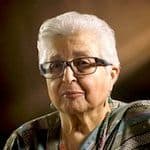
Interviews with Frene Ginwala
South Africa
Cultural and Sports Boycott
“The sports boycott was very effective.”
Transcript
The sports one [referring to the sports and cultural boycott of South Africa] was very effective because South Africa was very, very – white South Africa was very sports mad. Let me put it that way. And the fact that they were now being ostracized, it started with a coloured cricketer, who was a very good cricketer, but he was not allowed to travel on a South African team.
The Maoris [All Blacks] in New Zealand started putting pressure, saying if we go to South Africa, we must be allowed to go as New Zealanders, not as Maoris or have a special thing. So those were the sorts of thing that started making the impact. The Olympic games, South Africa was excluded. We had a South African nonracial Olympic movement, and they were doing – so these were offshoots. They were not under the control of the ANC [African National Congress]. We liaised with all of these people, but there were people themselves involved who were dealing with all of these different issues.
[The All Blacks are the national rugby team of New Zealand. The African National Congress (ANC) is a political party that served as the most prominent resistance movement against South Africa’s apartheid system, at times resorting to violence through its military wing, Umkhonto we Sizwe. It was officially banned by the South African government from 1960 to 1990. As apartheid collapsed, the ANC’s leader, Nelson Mandela, was elected President of South Africa in 1994 and established a democratic government.]
The cultural boycott, of course, took off tremendously, and a lot of people refused to come [to South Africa].
So it was a thing that moved with the times, with the situation as it happened, and it didn’t involve only the ANC. We supported it, but it was people’s consciences across the globe, whether it was Bono or it was somebody else.
[Bono (1960 – ) is the lead singer of U2 and a well-known social activist]
About Frene Ginwala
Frene Ginwala was born in 1932 in Johannesburg. A South African of Indian descent, Ginwala was keenly aware of the role race played in South African society. She studied law at the University of London and then returned to South Africa.
As political tensions rose between the white minority government and non-whites, Ginwala joined the African National Congress (ANC), the country’s main opposition group to the apartheid government. Following the 1960 Sharpeville Massacre, during which police shot at thousands of demonstrators protesting travel restrictions for non-whites, the government banned the ANC. Ginwala was tasked with coordinating the escape of senior ANC leader Oliver Tambo to Tanzania and establishing the organization’s external mission. She wouldn’t return to South Africa for thirty years.
During her exile, Ginwala headed the Political Research Unit in the Office of ANC President Oliver Tambo. She also served as the ANC spokesperson in the United Kingdom, often addressing matters on sanctions against South Africa’s apartheid government.
In 1990, President F.W. de Klerk’s government lifted the ANC ban and Ginwala returned to South Africa. Prior to the country’s first democratic elections in 1994, she helped set up the Women’s National Coalition, which gathered organizations from across the political spectrum to ensure women’s common interests were reflected in South Africa’s post-apartheid constitution. Ginwala was elected to parliament in 1994 where she served as Speaker of the National Assembly until 2004. As the first post-apartheid speaker, she was instrumental in setting a new course for the government, promoting an atmosphere of cooperation and reconciliation.
Since leaving government, Ginwala served as the First Chancellor of one of South Africa’s flagship universities, The University of Kwazula-Natal, until 2009. She has continued promoting democracy, good governance, development and human rights through her participation with various international organizations such as the United Nations and the International Institute for Democracy and Electoral Assistance.