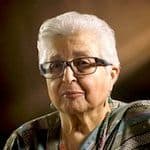
Interviews with Frene Ginwala
South Africa
Background
“And you always asked why, and there was never a satisfactory explanation.”
Transcript
I’m Frene Ginwala.
My grandfather came to Southern Africa in about 1870, so both in what was then Lorenco Marques [Portuguese colonial capital that is now Maputo, Mozambique] and into South Africa. I, because there were – my father did not want us studying in Portuguese, we were sent to school to what was then the Transvaal where we – but these schools, it didn’t matter where in South Africa they were. They were for different racial groups. So I was in the school which was for the Indian community because we were living around Johannesburg. And I studied here in primary school. And then I went – we were sent – my father insisted we get a proper education, and a good one, so we went to India on a visit, the first visit I’d been on. And then this was during World War II and ships were being torpedoed, so we then stayed in India for four years til after the war. By that time, I went to England and got my matric [matriculation] there, did my first university programs there.
[The Transvaal was the former northeastern province of South Africa that was settled by the Dutch-speaking people known as Afrikaners in 1830.]
Whatever you did was governed by politics – where you lived, which schools you could go to, whether you could go to a playground on the beach. You couldn’t; that was for whites only, and so political questions came up. But later on, we became more actively political. Mostly the Congress movement, and that was whether it was the Indian Congress, the African National Congress, used to have – the system was not so much individual membership as having public meetings, and every time deputations were being sent or when the case was going to the United Nations, these things would happen at public meetings, so large members of the community, large numbers went to these meetings.
[The Indian Congress movement started on a regional basis in 1894 to represent the interests of the Indian minority living in South Africa. By the 1920s, the various regional organizations functioned under the umbrella of the South African Indian Congress. The African National Congress (ANC) is a political party that served as the most prominent resistance movement against South Africa’s apartheid system, at times resorting to violence through its military wing, Umkhonto we Sizwe. It was officially banned by the South African government from 1960 to 1990. As apartheid collapsed, the ANC’s leader, Nelson Mandela, was elected President of South Africa in 1994 and established a democratic government.]
“Why can’t I go to that playground? Why do I have to travel all the way from Kenton Park where we were living to Johannesburg, when there were so many schools there?” And it was explained that the laws were such that you had to stay there. And then, obviously, you grew more conscious as you started asking questions. Now, Africans couldn’t be in the city or in the main urban centers without a permit.
Now, if you had somebody working in your house or wherever, you had to give a sort of letter saying this person is working here and has permission to be out. Now, I remember being asked to write the letter. It was a copy, and I remember after that saying, “Look, I’m only about twelve years old. Why am I giving permission to the person who looked after me to be able to walk out?” And my father would explain it to us, my mother would explain it to us. So we were all – I’m sure this was happening in all – most houses.
And you always asked why, and there was never a satisfactory explanation. It was after I left the Johannesburg school, that when the police raided the school, the kids would come out and they’d let down the tires of police cars. I mean, it was something they did automatically.
About Frene Ginwala
Frene Ginwala was born in 1932 in Johannesburg. A South African of Indian descent, Ginwala was keenly aware of the role race played in South African society. She studied law at the University of London and then returned to South Africa.
As political tensions rose between the white minority government and non-whites, Ginwala joined the African National Congress (ANC), the country’s main opposition group to the apartheid government. Following the 1960 Sharpeville Massacre, during which police shot at thousands of demonstrators protesting travel restrictions for non-whites, the government banned the ANC. Ginwala was tasked with coordinating the escape of senior ANC leader Oliver Tambo to Tanzania and establishing the organization’s external mission. She wouldn’t return to South Africa for thirty years.
During her exile, Ginwala headed the Political Research Unit in the Office of ANC President Oliver Tambo. She also served as the ANC spokesperson in the United Kingdom, often addressing matters on sanctions against South Africa’s apartheid government.
In 1990, President F.W. de Klerk’s government lifted the ANC ban and Ginwala returned to South Africa. Prior to the country’s first democratic elections in 1994, she helped set up the Women’s National Coalition, which gathered organizations from across the political spectrum to ensure women’s common interests were reflected in South Africa’s post-apartheid constitution. Ginwala was elected to parliament in 1994 where she served as Speaker of the National Assembly until 2004. As the first post-apartheid speaker, she was instrumental in setting a new course for the government, promoting an atmosphere of cooperation and reconciliation.
Since leaving government, Ginwala served as the First Chancellor of one of South Africa’s flagship universities, The University of Kwazula-Natal, until 2009. She has continued promoting democracy, good governance, development and human rights through her participation with various international organizations such as the United Nations and the International Institute for Democracy and Electoral Assistance.