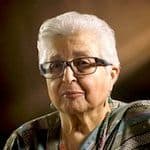
Interviews with Frene Ginwala
South Africa
Civics and Democracy
“Too often, democracy is seen as an event which happens once in five years.”
Transcript
Too often, democracy is seen as an event which happens once in five years. You go and vote. But it isn’t; it’s much more than that. It has to be. And this is where the education system and everything in society has to be.
You have to talk about responsibilities that you have as a citizen. It’s not enough to vote for a particular party or be members of a party. So the system of governance is very important, and here, for example, we have, at municipal level, tremendous problems with financial management. Now, when we think of the fact that an African could not open a spaza shop, corner shop, even in a township under apartheid, you realize the lack of experience and knowledge, not just experience running it, but knowledge about a cash economy, a community. So those are things that are still problems that we have to overcome.
[Spaza shops were small, informal shops that appeared in townships. Under apartheid, townships were residential areas designated for non-white groups. Non-whites were prohibited from living in areas reserved for whites.]
We have to transform the institutions because we had the institutions. As I said before that South Africa had all the institutions except democracy, except the involvement of the entire population. So the transformation of all the institutions still remains there before we can actually make it a true – what I would call a true democracy with the obligations, with the systems, with all the infrastructure of a democracy.
As part of negotiations [to end apartheid], I was on the negotiating thing that negotiated the independent electoral board and the whole election system. So you have to transform institutions. We had to do it quickly, and so many of them have not been done yet because they didn’t have the advantage that we had in Parliament where we agreed, blank sheet.
We – people going to, very often, given the level of unemployment, people see going into governance as a job, getting a job, getting a pay packet. It’s not necessarily corruption, but they see it as a method of going in rather than what they can do for the community. These are things which are inevitable, and you have to start changing them. It takes time to do that.
About Frene Ginwala
Frene Ginwala was born in 1932 in Johannesburg. A South African of Indian descent, Ginwala was keenly aware of the role race played in South African society. She studied law at the University of London and then returned to South Africa.
As political tensions rose between the white minority government and non-whites, Ginwala joined the African National Congress (ANC), the country’s main opposition group to the apartheid government. Following the 1960 Sharpeville Massacre, during which police shot at thousands of demonstrators protesting travel restrictions for non-whites, the government banned the ANC. Ginwala was tasked with coordinating the escape of senior ANC leader Oliver Tambo to Tanzania and establishing the organization’s external mission. She wouldn’t return to South Africa for thirty years.
During her exile, Ginwala headed the Political Research Unit in the Office of ANC President Oliver Tambo. She also served as the ANC spokesperson in the United Kingdom, often addressing matters on sanctions against South Africa’s apartheid government.
In 1990, President F.W. de Klerk’s government lifted the ANC ban and Ginwala returned to South Africa. Prior to the country’s first democratic elections in 1994, she helped set up the Women’s National Coalition, which gathered organizations from across the political spectrum to ensure women’s common interests were reflected in South Africa’s post-apartheid constitution. Ginwala was elected to parliament in 1994 where she served as Speaker of the National Assembly until 2004. As the first post-apartheid speaker, she was instrumental in setting a new course for the government, promoting an atmosphere of cooperation and reconciliation.
Since leaving government, Ginwala served as the First Chancellor of one of South Africa’s flagship universities, The University of Kwazula-Natal, until 2009. She has continued promoting democracy, good governance, development and human rights through her participation with various international organizations such as the United Nations and the International Institute for Democracy and Electoral Assistance.