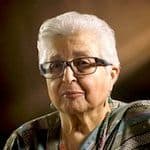
Interviews with Frene Ginwala
South Africa
Mandela and Tambo
Frene Ginwala: Mandela and Tambo
Transcript
Oliver Tambo also, as the voice of the ANC [African National Congress], was the person who kept the ANC together in exile. I don’t know there’s any other political group that did not fragment, but from 1960 til 1991, when Oliver Tambo came back [to South Africa from exile], he held the ANC together. He was the acknowledged leader. Mandela was, but in a mythical kind of way. He was in prison, and the campaign for release of political prisoners was on his – the campaign was launched, but the ANC never had agreed to isolate one leader above others.
So when we went back to headquarters and said we need a face for the type of campaign you are talking about, and we suggested it was Nelson Mandela because Nelson Mandela’s speech – when he had gone back to South Africa, he was then imprisoned, or tried, for leaving the country illegally and his speech at the treason trial had gone around the world and his words – it had been broadcast all over in many, many countries. It was read from the pulpit of St. Paul’s Cathedral [London, United Kingdom], which would sound odd, which it was, because here was somebody who was supposedly a terrorist.
[The ANC is a political party that served as the most prominent resistance movement against South Africa’s apartheid system, at times resorting to violence through its military wing, Umkhonto we Sizwe. It was officially banned by the South African government from 1960 to 1990. As apartheid collapsed, the ANC’s leader, Nelson Mandela, was elected President of South Africa in 1994 and established a democratic government. Oliver Tambo (1917 – 1993) was an anti-apartheid activist and a senior leader of the ANC. He served as the organization’s president from 1967 – 1991 and kept the ANC together from exile after it was banned by the South African government in 1960. Nelson Mandela (1918 – 2013) was a South African anti-apartheid revolutionary and politician who served as the first post-apartheid President of South Africa from 1994-1999. After returning from an international trip, Nelson Mandela was arrested and tried in1962. He was accused on two counts: inciting persons to strike illegally and leaving the country without a valid passport. Mandela was found guilty and sentenced to five years in prison. In 1963, while still serving his sentence, Mandela was put on trial again and sentenced to life in prison.]
So that had been there, but we had to ask for permission. Now, the channel of communication with South Africa was Oliver Tambo. How he communicated was the internal machinery, but then again, there was a leadership on the island, Robben Island. Now, there was an ANC there, which was headed by Nelson Mandela.
The external mission was headed by Oliver Tambo. And they went back to the island, got agreement that we could use the name of Nelson Mandela. In other words, draw him out as not just part of a collective. So then the international campaign was release all South Africans – Nelson Mandela and all political prisoners. This is – so the movement – [the African National] Congress worked as one, though it was in different places and different groups doing different things
[Robben Island, now a museum, was the site of a maximum security prison where Nelson Mandela and other political prisoners were jailed.]
Oliver Tambo was the internationally-recognized leader, liaising with governments, liaising – for example, the first meeting we had with Mrs. Thatcher was with Oliver Tambo because Mandela was in prison, and this was the way we worked because of their very close respect for each other and because they’d worked together from the time they were students and in the leadership of the ANC before it was banned. He was a very humane individual.
[Margaret Thatcher (1925 – 2013) served as the Prime Minister of the United Kingdom from 1979-1990]
About Frene Ginwala
Frene Ginwala was born in 1932 in Johannesburg. A South African of Indian descent, Ginwala was keenly aware of the role race played in South African society. She studied law at the University of London and then returned to South Africa.
As political tensions rose between the white minority government and non-whites, Ginwala joined the African National Congress (ANC), the country’s main opposition group to the apartheid government. Following the 1960 Sharpeville Massacre, during which police shot at thousands of demonstrators protesting travel restrictions for non-whites, the government banned the ANC. Ginwala was tasked with coordinating the escape of senior ANC leader Oliver Tambo to Tanzania and establishing the organization’s external mission. She wouldn’t return to South Africa for thirty years.
During her exile, Ginwala headed the Political Research Unit in the Office of ANC President Oliver Tambo. She also served as the ANC spokesperson in the United Kingdom, often addressing matters on sanctions against South Africa’s apartheid government.
In 1990, President F.W. de Klerk’s government lifted the ANC ban and Ginwala returned to South Africa. Prior to the country’s first democratic elections in 1994, she helped set up the Women’s National Coalition, which gathered organizations from across the political spectrum to ensure women’s common interests were reflected in South Africa’s post-apartheid constitution. Ginwala was elected to parliament in 1994 where she served as Speaker of the National Assembly until 2004. As the first post-apartheid speaker, she was instrumental in setting a new course for the government, promoting an atmosphere of cooperation and reconciliation.
Since leaving government, Ginwala served as the First Chancellor of one of South Africa’s flagship universities, The University of Kwazula-Natal, until 2009. She has continued promoting democracy, good governance, development and human rights through her participation with various international organizations such as the United Nations and the International Institute for Democracy and Electoral Assistance.