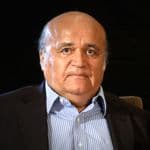
Interviews with Genaro Arriagada
Chile
The Start of the No Campaign
“Our program was human rights, democracy, social justice and a new political order.”
Transcript
The story of the “No” campaign begins about three years prior to the referendum and has much to do with the fact that we were profoundly moved by what had happened in the Philippines. [The “No” campaign was a Chilean campaign to persuade citizens to vote “No” in the 1988 nation-wide plebiscite that would have prolonged the rule of the Pinochet regime.]
… Where a referendum, an election, a movement for free elections had defeated Marcos’ dictatorship.
[Ferdinand Emmanuel Edralin Marcos, Sr. (1917 – 1989) was a Filipino lawyer and politician who served as President of the Philippines from 1965 to 1986.]
In turn, we arrived at the conviction that if we wanted to get rid of Pinochet’s dictatorship, we had to do so upon the basis of a simple agenda that would succeed in mobilizing the people.
[Augusto Pinochet (1915-2006) was dictator of Chile between 1973 and 1990.]
That agenda was human rights, democracy, greater social justice and a new political order where there would be a place for everyone, including the supporters of the dictatorship.
For this reason, we spoke of wanting a homeland for all. Some movements for free elections were formed. The opposition was very fragmented.
There were about thirty political groups. The inevitable result of dictatorships is that small parties begin to form. Then three free elections committees were formed.
One for the left, headed by Ricardo Lagos, one for the Christian Democrats and the Radicals, headed by Andrés Zaldívar, and one comprised of personalities from the intellectual world – writers, painters, and some of the country’s prominent moral figures.
[Ricardo Lagos Escobar (1938 – ) is a lawyer, economist and social democrat politician, who served as president of Chile from 2000 to 2006.]
[Andrés Rafael Zaldívar (1936 – ) is a prominent Chilean Christian Democrat politician.]
There was an agreement to name a joint executive secretary for those three movements. I ended up being the joint secretary of the three movements for free elections.
As the referendum drew near, the Concertación coalition was created, which is the Coalition of Parties for Democracy; then the “Command for No” was created. It was sort of reasonable that if I had been three committees’ secretary… there was an agreement that I had to be the operational head of the Command.
[The Concertación is a coalition of primarily center-left political parties in Chile. The Command for the No was the anti-Pinochet campaign organized for the 1988 referendum.]
But much more important than the personal thing was the fact that we formed a remarkable campaign in every sense.
…Because it was a coming together of groups with very different philosophies, that in the past had had big differences: some supporters of Salvador Allende, others supporters of Eduardo Frei, some split from the dictatorship.
[Salvador Allende (1908-1973) was president of Chile between 1970 and 1973.] [Eduardo Frei Montalva (1911 –1982) was president of Chile from 1964 to 1970.]
There were only a few from the right but they were very important. So a group of people comes and begins to sketch out a dream of the country, which was not to turn the tables [in revenge]. On the contrary, if the tortured became torturers, if the victims became victimizers, that would be our downfall.
What we had to do was to create a way where people could feel they were part of a process. That meant respecting the rights even of those who favored the military regime. But human rights abuses were a different problem, because those were crimes.
Those were crimes that were condemned by the Penal Code, by universal legislation, by international treaties. Consequently, those responsible had to go to prison. But not for their political beliefs, but rather for their crimes.
That is what the Chilean transition has done better than any other transition I know of.
Here, all of the generals that were heads of the political police have been prosecuted and the majority has been imprisoned. The number of people that have been prosecuted for human rights violations has no parallel with what was done in the Soviet Union, where to my knowledge no one was condemned…
In the German Democratic Republic, in East Germany, they could not even prosecute [Erich] Honecker, the dictator, because at the time of the prosecution they chose to declare him incapable of standing judgment due to his age. Honecker came to Chile to die.
[Erich Honecker (1912 –1994) was a German politician who, as the General Secretary of the Socialist Unity Party, led East Germany from 1971 until the weeks preceding the fall of the Berlin Wall in 1989.]
Here there was a great effort to create a common space of civilized coexistence between those of the right, the left, and the center, and at the same time, to punish, to judge those who had committed violations, crimes, and torture. In that sense the Chilean transition was a notable effort to carry out justice. But it was also very notable in how it restored and reestablished rights for all.
About Genaro Arriagada
Genaro Arriagada Herrera is a Chilean attorney, political scientist, diplomat and politician.
Arriagada was born in 1943 and studied law at the University of Chile, graduating in 1965. He became active in politics and affiliated with the Christian Democratic Party in 1963. He worked on several of the party’s political campaigns. Following the military coup d’état in 1973, the regime of General Augusto Pinochet banned political parties. Arriagada became active in the democratic opposition to the military regime. From 1980 to 1989, he served as vice president of the Christian Democrats.
In 1988, Arriagada was chosen as Executive Secretary of the Concertación, the Coalition of Parties for Democracy, a broad coalition of political parties from across the political spectrum that opposed the military government.
In October 1988, the Pinochet regime called a national referendum asking Chileans whether they wanted to continue the military regime. As Executive Secretary of the Concertación, Arriagada became the director of the historic “No” Campaign, which opposed extending military rule. The opposition organized a large voter registration effort and mounted an upbeat campaign that urged voters to restore democracy to Chile.
As Chile returned to the democratic path, Arriagada served in multiple senior positions. He led Eduardo Frei Ruiz-Tagle’s successful presidential campaign in 1993 and then served as a minister in his government. He also ran the successful presidential campaign of Ricardo Lagos in 1999. In the late 1990s, Arriagada served as Chile’s ambassador to the United States.
Since leaving government service, Arriagada has held a variety of academic positions and has been affiliated with institutions such as the University of the Americas, the Inter-American Dialogue, the Wilson Center, and Harvard University’s Institute of Politics. He has also worked with democratic groups in countries like Bulgaria, Cuba, Nicaragua, Panama, Paraguay and Serbia.