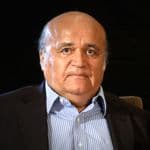
Interviews with Genaro Arriagada
Chile
The Price of Politics
“The regime attacked them without any concern for their dignity or their rights.”
Transcript
Chile is a very small society. If I were to list of my university classmates who were murdered, there would be many.
We had profound differences with Socialist and Communist party members, but they had been our university classmates. We had been political adversaries but we accepted each other. Consequently, the number of people that I know that were tortured is peculiar for a small society like ours.
Fortunately, I was not a victim of that. I was not a victim. Even though I was one of the most prominent critics during those years. I think it was due to the fact that the [Pinochet] regime defined its enemy as the parties of the Marxist left. The regime attacked them without any concern for their dignity or their rights.
For those people, the price for being involved in politics was the risk of assassination. On the other hand, we Christian Democrats had our offices and newspapers seized. The party was banned. But the price for our involvement in politics was not our lives.
About Genaro Arriagada
Genaro Arriagada Herrera is a Chilean attorney, political scientist, diplomat and politician.
Arriagada was born in 1943 and studied law at the University of Chile, graduating in 1965. He became active in politics and affiliated with the Christian Democratic Party in 1963. He worked on several of the party’s political campaigns. Following the military coup d’état in 1973, the regime of General Augusto Pinochet banned political parties. Arriagada became active in the democratic opposition to the military regime. From 1980 to 1989, he served as vice president of the Christian Democrats.
In 1988, Arriagada was chosen as Executive Secretary of the Concertación, the Coalition of Parties for Democracy, a broad coalition of political parties from across the political spectrum that opposed the military government.
In October 1988, the Pinochet regime called a national referendum asking Chileans whether they wanted to continue the military regime. As Executive Secretary of the Concertación, Arriagada became the director of the historic “No” Campaign, which opposed extending military rule. The opposition organized a large voter registration effort and mounted an upbeat campaign that urged voters to restore democracy to Chile.
As Chile returned to the democratic path, Arriagada served in multiple senior positions. He led Eduardo Frei Ruiz-Tagle’s successful presidential campaign in 1993 and then served as a minister in his government. He also ran the successful presidential campaign of Ricardo Lagos in 1999. In the late 1990s, Arriagada served as Chile’s ambassador to the United States.
Since leaving government service, Arriagada has held a variety of academic positions and has been affiliated with institutions such as the University of the Americas, the Inter-American Dialogue, the Wilson Center, and Harvard University’s Institute of Politics. He has also worked with democratic groups in countries like Bulgaria, Cuba, Nicaragua, Panama, Paraguay and Serbia.