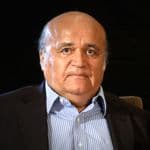
Interviews with Genaro Arriagada
Chile
Building Alliances
“The defense of human rights helped in the rebuilding of old friendships.”
Transcript
To start, the Christian Democrats remain with a feeling of guilt in the sense that we contributed to the coup d’état.
We contributed by the fact that our opposition to Salvador Allende was so strong that it contributed to the destruction of democracy. We were not the only ones. It was all of us. But that was our responsibility.
[Salvador Allende (1908-1973) was president of Chile between 1970 and 1973. He was removed from office in a military coup d’état.]
The defense of human rights helped in the rebuilding of old friendships. We began to discover that, regardless of our differences, we were partners in the basics – in the dignity of persons, in a sense of decency, and in justice – once again, we were comrades.
For example, I remember that the Vicariate of Solidarity, which was a great Catholic Church organization for the defense of human rights, invited two of us who wrote, intellectuals per se, Manuel Antonio Garretón and me- to each write a report about the doctrines of national security that were the ideological pillars of the regime. [The Vicariate of Solidarity, an agency of the Chilean Catholic Church, was a human rights organization in Chile during the military regime of Augusto Pinochet.] [Manuel Antonio Garretón (1943 – ) is a Chilean politician and sociologist]
We each began to write on our own. Around sixty days into the project, Garretón – who was solidly pro-Salvador Allende government – and I – who had opposed Allende – came together and said: Why are we going to write separately if we can write an article together?
Together we wrote an article. Two years had passed since the military coup d’état. A convergence was occurring, helped by the brutality of the regime, because that brutality brought us together.
After that, in the world of Salvador Allende’s supporters, many of the leaders left for exile. They left for East Germany, the Soviet Union, Bulgaria, and Czechoslovakia.
And there, a process of maturation occurred, which is written about in many books written by those leaders, in which upon arriving to “the promised land,” they realized that the promised lands were in fact bureaucratic, inefficient dictatorships. Then the left abandons Marxism-Leninism and begins to align more with a social democratic mindset. [Marxism–Leninism is a term invented by Joseph Stalin to describe the political ideology adopted, under his rule, by the Communist Party of the Soviet Union]
There began an ideological convergence of a growing sense of value of human rights, of democracy.
There is an assessment of the friendship formed in the fight against repression and for the rights of the persecuted.
There is disenchantment in many of the forces that were more orthodox Marxist. There is disenchantment with actual socialism. That created deep relationships [and] noble friendships.
About Genaro Arriagada
Genaro Arriagada Herrera is a Chilean attorney, political scientist, diplomat and politician.
Arriagada was born in 1943 and studied law at the University of Chile, graduating in 1965. He became active in politics and affiliated with the Christian Democratic Party in 1963. He worked on several of the party’s political campaigns. Following the military coup d’état in 1973, the regime of General Augusto Pinochet banned political parties. Arriagada became active in the democratic opposition to the military regime. From 1980 to 1989, he served as vice president of the Christian Democrats.
In 1988, Arriagada was chosen as Executive Secretary of the Concertación, the Coalition of Parties for Democracy, a broad coalition of political parties from across the political spectrum that opposed the military government.
In October 1988, the Pinochet regime called a national referendum asking Chileans whether they wanted to continue the military regime. As Executive Secretary of the Concertación, Arriagada became the director of the historic “No” Campaign, which opposed extending military rule. The opposition organized a large voter registration effort and mounted an upbeat campaign that urged voters to restore democracy to Chile.
As Chile returned to the democratic path, Arriagada served in multiple senior positions. He led Eduardo Frei Ruiz-Tagle’s successful presidential campaign in 1993 and then served as a minister in his government. He also ran the successful presidential campaign of Ricardo Lagos in 1999. In the late 1990s, Arriagada served as Chile’s ambassador to the United States.
Since leaving government service, Arriagada has held a variety of academic positions and has been affiliated with institutions such as the University of the Americas, the Inter-American Dialogue, the Wilson Center, and Harvard University’s Institute of Politics. He has also worked with democratic groups in countries like Bulgaria, Cuba, Nicaragua, Panama, Paraguay and Serbia.