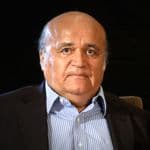
Interviews with Genaro Arriagada
Chile
Pinochet's Brutal Coup
“Within 48 hours the army had control over the entire country.”
Transcript
At the time of the coup d’état there were clashes in the streets and, consequently, one could suppose that there were a few deaths due to those confrontations. The truth is that within forty-eight hours the army had control over the entire country.
What followed was extreme violence against those persons who were defeated. They were neither judged nor put on trial. They were simply suppressed either by assassination or worse, to the extent in which the regime became organized, by the creation of concentration camps (of which there were many), or by expulsion into exile…
It is estimated that during those months, twenty thousand people went in exile. People that belonged to the Movement of the Revolutionary Left, the Communist Party, and the Socialist Party were detained and subjected to torture. At least three thousand people disappeared whose bodies were never found.
The consensus in Chile is that these three thousand people were those that died in the torture chambers and whose bodies were later made to disappear.
We are facing a regime with a brutal degree of criminality. And I tell you today, we always opposed that regime.
It was a brutal regime. We are talking about assassination and torture. We are talking about exile. Besides that it is a regime that prohibited political parties; that dissolved all powers of local government, that seized the universities, and that established a curfew that lasted twelve years.
It censored books, impeded the existence of a free press with (it is necessary to say) a few small media exceptions that survived the persecution. One of them was the Radio Cooperativa, of which I was the president for fourteen years during the military regime.
About Genaro Arriagada
Genaro Arriagada Herrera is a Chilean attorney, political scientist, diplomat and politician.
Arriagada was born in 1943 and studied law at the University of Chile, graduating in 1965. He became active in politics and affiliated with the Christian Democratic Party in 1963. He worked on several of the party’s political campaigns. Following the military coup d’état in 1973, the regime of General Augusto Pinochet banned political parties. Arriagada became active in the democratic opposition to the military regime. From 1980 to 1989, he served as vice president of the Christian Democrats.
In 1988, Arriagada was chosen as Executive Secretary of the Concertación, the Coalition of Parties for Democracy, a broad coalition of political parties from across the political spectrum that opposed the military government.
In October 1988, the Pinochet regime called a national referendum asking Chileans whether they wanted to continue the military regime. As Executive Secretary of the Concertación, Arriagada became the director of the historic “No” Campaign, which opposed extending military rule. The opposition organized a large voter registration effort and mounted an upbeat campaign that urged voters to restore democracy to Chile.
As Chile returned to the democratic path, Arriagada served in multiple senior positions. He led Eduardo Frei Ruiz-Tagle’s successful presidential campaign in 1993 and then served as a minister in his government. He also ran the successful presidential campaign of Ricardo Lagos in 1999. In the late 1990s, Arriagada served as Chile’s ambassador to the United States.
Since leaving government service, Arriagada has held a variety of academic positions and has been affiliated with institutions such as the University of the Americas, the Inter-American Dialogue, the Wilson Center, and Harvard University’s Institute of Politics. He has also worked with democratic groups in countries like Bulgaria, Cuba, Nicaragua, Panama, Paraguay and Serbia.