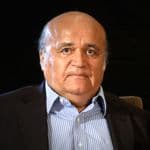
Interviews with Genaro Arriagada
Chile
Importance of Democracy
“In politics one must see democracy as the only political system that guarantees liberty.”
Transcript
I believe that more so than freedom, which is of course the foundation, in politics one must see democracy as the only political system that guarantees liberty.
That means free elections; alternation in power, where the one that wins the election can take power and the one who loses does not have to go into exile or be tortured, but rather is a legitimate opposition.
At the same time democracy is much more than elections. Democracy supposes a foundation of equality.
It makes no sense to say, “we are equally free under the law” when there are some (among whom I count myself) who have a good economic standing and there are others that live in poverty. Of course, law does not solely determine my level of freedom.
My level of freedom is also determined by the social and cultural capital, my level of education, my income. At the same time, the freedoms that a person at the bottom of the social and income pyramid are few.
In the end, their lives are about getting two dollars a day to eat. So, democracy requires an important dosage of equality.
In Latin America inequality is very large and our democracy is affected by it.
We want free elections. Without a doubt, it is fundamental. But we need greater equality.
Without equality, freedom is worth little. Freedom is for those of us who have money. I do not say “exclusively,” to be clear.
Military regimes repress everyone, particularly the poorest. So that the poorest have a real interest in democracy. We have to be able to give them the tools so they can use those freedoms.
Another thing that is very complicated in Latin America is that we are holding many elections but we have little rule of law. What one wants, without a doubt, in Latin America is to have elections; to have more justice so that freedoms are more real; and third, that we have a division of powers.
To have an independent judiciary that protects our rights when they are abused by the executive.
That is the dream. Latin America is far from completing that dream. But we have made progress.
About Genaro Arriagada
Genaro Arriagada Herrera is a Chilean attorney, political scientist, diplomat and politician.
Arriagada was born in 1943 and studied law at the University of Chile, graduating in 1965. He became active in politics and affiliated with the Christian Democratic Party in 1963. He worked on several of the party’s political campaigns. Following the military coup d’état in 1973, the regime of General Augusto Pinochet banned political parties. Arriagada became active in the democratic opposition to the military regime. From 1980 to 1989, he served as vice president of the Christian Democrats.
In 1988, Arriagada was chosen as Executive Secretary of the Concertación, the Coalition of Parties for Democracy, a broad coalition of political parties from across the political spectrum that opposed the military government.
In October 1988, the Pinochet regime called a national referendum asking Chileans whether they wanted to continue the military regime. As Executive Secretary of the Concertación, Arriagada became the director of the historic “No” Campaign, which opposed extending military rule. The opposition organized a large voter registration effort and mounted an upbeat campaign that urged voters to restore democracy to Chile.
As Chile returned to the democratic path, Arriagada served in multiple senior positions. He led Eduardo Frei Ruiz-Tagle’s successful presidential campaign in 1993 and then served as a minister in his government. He also ran the successful presidential campaign of Ricardo Lagos in 1999. In the late 1990s, Arriagada served as Chile’s ambassador to the United States.
Since leaving government service, Arriagada has held a variety of academic positions and has been affiliated with institutions such as the University of the Americas, the Inter-American Dialogue, the Wilson Center, and Harvard University’s Institute of Politics. He has also worked with democratic groups in countries like Bulgaria, Cuba, Nicaragua, Panama, Paraguay and Serbia.