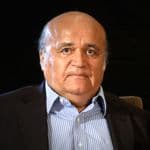
Interviews with Genaro Arriagada
Chile
Implementation of the No Campaign
“The people wanted a message of confidence, of joy.”
Transcript
We understood that campaign should be three or four very important things. I have already spoken of one: a reasonable program, for the people to feel that the coming democracy was a real democracy, where everybody could find their place under the sun.
Second: people had to be registered to vote. We managed to register seven and a half million. It was a great effort because at first people would say: “Why would we register if this will be a fraudulent referendum?” We would answer: “We will make sure that this is not a fraudulent referendum. So, register!”
Different people began to register. I remember one: Salvador Allende’s widow. When she was allowed to return [to Chile], she arrived at the Santiago
Airport and the first thing she said was “I come to register.” That was a very important shock because her statement led many of Allende’s supporters who did not want to register to do so.
[Salvador Allende (1908-1973) was president of Chile between 1970 and 1973.]
At the end, during the last sixty days, the Communist Party called [on citizens] to register. That was a task.
The second task was how to create a non-intimidating campaign that did not create fear. We made great efforts to research that. We conducted focus groups for the first time ever in Chile. /
I remember we also brought in Peter Hart, a distinguished American pollster. We brought in some Spaniards. We conducted a lot of research. What did the research show? The people wanted a message of confidence, of joy.
They did not want something that took them back to the past. I will put it in an interesting way, because the surveys showed that the human rights theme was not of much importance. We asked ourselves why if the dictatorship has been so strong, why wasn’t the theme of human rights more important.
The focus groups showed that it was not that it wasn’t important, but rather that the idea of reliving the torture, assassination, created an adverse reaction as if to say: “we are going to return to more of the same.”
So, what did we do? We said: we are going to pose the human rights problem in terms of it being a message about the future and not a message of revenge.
About Genaro Arriagada
Genaro Arriagada Herrera is a Chilean attorney, political scientist, diplomat and politician.
Arriagada was born in 1943 and studied law at the University of Chile, graduating in 1965. He became active in politics and affiliated with the Christian Democratic Party in 1963. He worked on several of the party’s political campaigns. Following the military coup d’état in 1973, the regime of General Augusto Pinochet banned political parties. Arriagada became active in the democratic opposition to the military regime. From 1980 to 1989, he served as vice president of the Christian Democrats.
In 1988, Arriagada was chosen as Executive Secretary of the Concertación, the Coalition of Parties for Democracy, a broad coalition of political parties from across the political spectrum that opposed the military government.
In October 1988, the Pinochet regime called a national referendum asking Chileans whether they wanted to continue the military regime. As Executive Secretary of the Concertación, Arriagada became the director of the historic “No” Campaign, which opposed extending military rule. The opposition organized a large voter registration effort and mounted an upbeat campaign that urged voters to restore democracy to Chile.
As Chile returned to the democratic path, Arriagada served in multiple senior positions. He led Eduardo Frei Ruiz-Tagle’s successful presidential campaign in 1993 and then served as a minister in his government. He also ran the successful presidential campaign of Ricardo Lagos in 1999. In the late 1990s, Arriagada served as Chile’s ambassador to the United States.
Since leaving government service, Arriagada has held a variety of academic positions and has been affiliated with institutions such as the University of the Americas, the Inter-American Dialogue, the Wilson Center, and Harvard University’s Institute of Politics. He has also worked with democratic groups in countries like Bulgaria, Cuba, Nicaragua, Panama, Paraguay and Serbia.