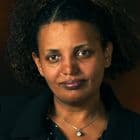
Interviews with Birtukan Midekssa
Ethiopia · Interviewed October 3, 2012
Role of Women
You find very strong women but we don’t see the participation of women in political leadership.
Transcript
Women as leaders in Ethiopian society. Let me just try to focus on only political leadership. In a way, it’s – the irony is like if you look into the political history of the governing party when they were engaged in an armed struggle, like 30 percent of the soldiers, they were women. And you know, they were known for taking women as partners – equal partners, you know, in any kind of political stride. And after they came to power, you know, they just came up with their masculine face. You know what I mean? You don’t find anybody with significant influence within the party with you who is a woman, you know?
So even that process – the struggle of this party which is in power, which accommodates the participation of women, you know, it didn’t achieve anything; it didn’t bring about anything in terms of empowering women, in terms of political leadership. That’s really saddening. Yeah, but – yeah, you know, always equality and empowerment and all those things are directly correlated with having democracy, whether internally or in the national political sphere. So you know, a political party known for autocratic method of, you know, political process couldn’t kind of assure, you know, equality for women in any way.
When we – when you come to opposition politics, of course there are a lot of obstacles for women to come to political participation, the opposition. Of course there is a cultural component into it. But there is also, you know, this difficulty with regards to the role as a mother or, you know, as a – you know, as somebody who takes care of the family affairs, you know. I remember when we were in prison in 2005, of course many women, you know, had to share that plight. And the saddening part was, you know, those mothers, you know, had to – their suffering was kind of double-fold, you know?
They suffered as prisoners, you know, facing that horrible condition in prison, and they suffer as mothers leaving behind their children and, you know, seeing that the family members and that the family as a whole facing all kinds of challenge because of their absence. And even one of my co-defendants, she was a journalist. And we were in prison, she realized she was pregnant. And she had to spend that time of her pregnancy in a very bad prison condition. She had to live with 70 people in a very packed manner, you know what I mean, very narrow cell and with all kind – types of criminals, you know, murderers, you know, people who committed robbery and all kinds of crimes. And even mentally ill people, you know, were supposed to live with us. She had to endure all that, you know. She was – she was having her own medical problem and she wanted, you know, the normal prenatal care, but she didn’t have it. And she had to handle that kind of living environment. And she had to give birth to her first child while we were there.
So the realm of political opposition for women, you know, the challenge it poses is kind of double-fold, because of the role they have in the society as mothers, as wives and, you know, as a responsible woman, you know, taking care of the well-being of the family. So that is, in a way, discouraging for a woman to come at the forefront. But regardless of this, you find very strong women, you know, in every level who dares to defy, and who committed their life to pay the price necessary for this noble cause and – but, you know, because of this cumulative factors, we don’t see the participation of women in political leadership and political participation as we need to.
About Birtukan Midekssa
Birtukan Midekssa is a former federal judge and leader of the pro-democracy opposition movement in Ethiopia.
Hailed as the Aung San Suu Kyi of her country, she was sentenced to life in prison in 2005 after her party, the Coalition for Unity and Democracy, won an unprecedented number of seats in parliamentary elections. After eighteen months in prison, she was pardoned in 2007 following a series of high-level negotiations. Upon her release, she founded the Unity for Democracy and Justice Party (UDJ) and was elected its first chairperson. In 2008, she was rearrested for allegedly having violated the terms of her pardon and remained in prison for almost two more years. In 2010, she was shortlisted for the European Parliament’s 2010 Sakharov Prize for Freedom of Thought.
Prior to entering politics, Ms. Midekssa served as a defense attorney and federal judge, rendering numerous court decisions in support of the rule of law and in defense of fundamental constitutional liberties. She drew the ire of the Ethiopian government when she presided as a judge in a high profile corruption case involving the former defense minister, Siye Abraha. Ms. Midekssa released Abraha for lack of evidence, but the government immediately rearrested him and sent him to jail for seven years. The government’s contempt for the rule of law helped motivate Birtukan Midekssa to become active in politics.
She was selected as a Reagan-Fascell Democracy Fellow for 2011-2012 at the National Endowment for Democracy and as a Scholar at Risk Fellow at the W.E.B. DuBois Institute at Harvard University for 2012 – 2013.