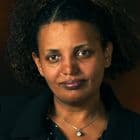
Interviews with Birtukan Midekssa
Ethiopia · Interviewed October 3, 2012
Becoming a Lawyer
I was full of excitement to join the judiciary and give some kind of public service to my community.
Transcript
Even now, you may not find, you know, too many judges or attorneys in the legal sphere in Ethiopia. But in my town, it was more so. And actually, in my career, I had the chance to deal with some very political sensitive cases. So the way I handled and the way people took it – one of the factors which has, you know, arisen to – in a way, to admire me, was that, you know, I was a woman, you know, to, you know, to stick to legal principles and handle cases with, you know, ethical and professional manner.
So people gave me such admiration, not only because I was committed to my professional principles, but because I was a woman as well. After I joined law school, you know, the more I learned about justice, civil liberties, and, you know, how, you know, legal professional – how legal institution could serve, you know, in establishing a society with tenets of justice, equality and human dignity, that is really an inspiration and, you know, it gave me a huge passion.
And I was full of excitement to join the judiciary at some point, and to give some kind of public service to my community, to the public. So immediately after I graduated I applied to join the federal court, and initially I was hired as an assistant for a judge, or you might consider it as a clerk, and I served – I worked in that position for two years or so, then immediately we got recruited and, you know, the parliament approved the assignment of some of those fresh graduates from the law school to be a judge in the first instance court. So that was really, you know, a moment of excitement and, you know, a moment of passion for me.
About Birtukan Midekssa
Birtukan Midekssa is a former federal judge and leader of the pro-democracy opposition movement in Ethiopia.
Hailed as the Aung San Suu Kyi of her country, she was sentenced to life in prison in 2005 after her party, the Coalition for Unity and Democracy, won an unprecedented number of seats in parliamentary elections. After eighteen months in prison, she was pardoned in 2007 following a series of high-level negotiations. Upon her release, she founded the Unity for Democracy and Justice Party (UDJ) and was elected its first chairperson. In 2008, she was rearrested for allegedly having violated the terms of her pardon and remained in prison for almost two more years. In 2010, she was shortlisted for the European Parliament’s 2010 Sakharov Prize for Freedom of Thought.
Prior to entering politics, Ms. Midekssa served as a defense attorney and federal judge, rendering numerous court decisions in support of the rule of law and in defense of fundamental constitutional liberties. She drew the ire of the Ethiopian government when she presided as a judge in a high profile corruption case involving the former defense minister, Siye Abraha. Ms. Midekssa released Abraha for lack of evidence, but the government immediately rearrested him and sent him to jail for seven years. The government’s contempt for the rule of law helped motivate Birtukan Midekssa to become active in politics.
She was selected as a Reagan-Fascell Democracy Fellow for 2011-2012 at the National Endowment for Democracy and as a Scholar at Risk Fellow at the W.E.B. DuBois Institute at Harvard University for 2012 – 2013.