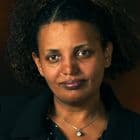
Interviews with Birtukan Midekssa
Ethiopia · Interviewed October 3, 2012
Birtukan Enters Politics
I decided to run for parliament in 2000. But the election was not free and competitive.
Transcript
My life during my childhood – actually, my academic life in the law school and, on the other hand, the political change we’re having in our country, all those things, you know, were in a way motivating for me to try to contribute something for the fight, for the struggle to see some kind progress in terms of democracy and human rights protection. So I decided to run for parliament in 2000. I was an independent candidate. But on the other hand, you know, the election was not free and competitive. Even most of the political parties were boycotting the election, for two reasons.
One, they were weakened by, you know, successive attacks and intimidation they were subject to. And, you know, at the same time, they knew if they came out as a strong opponent of the governing party, you know, things may not – may not be favorable to show or to give towards some kind of achievement. So that is the environment I was running in. But for me as a young lady, I was an age of 26, it was an exciting experience.
It gave me a chance to look into the experience of, you know, the regular people, you know, in our community, and to hear through different people how they view our politics and how they view being an opposition, being a supporter of governing party, how they view becoming a dissident or be viewing – or, you know, airing a dissenting opinion. So that was a very good experience for me. And that is the thing, you know, I could consider as an achievement from that process.
So, you know, after I run as an independent candidate, I tried to, you know, research out about the views and the articulation of the opposition parties. Obviously, you know, they were the voice for the cause of democracy. And, of course, they contributed a lot, you know, in keeping the voice alive. But, you know, I was not sure they were having, you know, an internal democracy within their parties, and I was not sure they were not part of the undemocratic political culture. In a way, it’s part of our political culture, which is giving us a hard time, both in the governing party and in the opposition. So I was reluctant whether I should join the political parties or not.
You know, I was not able to make sure people who are coming at the forefront in the opposition parties are really embracing those ideals and really committed to implement those ideals in – you know, even in their day-to-day political activity. So I was hesitant, in a way. I had reservations with regards to the opposition as well. But in 2005, when CUD, Coalition for Unity and Democracy, was set up, you know, I saw interesting developments. You know, very prominent academic leaders who were able to articulate those ideas of freedom and democracy were joining the party. And, you know, the dynamics was changed in a way, you know.
So, you know, that made me very interested. And – you know, and not only about the parties; the whole political process was, you know, undergoing some kind of change. You know, when – even the people from the governing party accepted now that they were opening of the political space so that they can have a better international image. But in a way, it seemed like, you know, it was meant to see real change. So even the governing party was opening up the space. And, you know, it was showing unprecedented practices in terms of, you know, allowing the opposition to have access to media and allowing the free press to, you know, have more space in terms of criticizing the government, in terms of expressing different political views and, you know, issues. So all those things together, I thought that was the right time to commit oneself and to try to see some kind of progress in terms of a democratic development.
About Birtukan Midekssa
Birtukan Midekssa is a former federal judge and leader of the pro-democracy opposition movement in Ethiopia.
Hailed as the Aung San Suu Kyi of her country, she was sentenced to life in prison in 2005 after her party, the Coalition for Unity and Democracy, won an unprecedented number of seats in parliamentary elections. After eighteen months in prison, she was pardoned in 2007 following a series of high-level negotiations. Upon her release, she founded the Unity for Democracy and Justice Party (UDJ) and was elected its first chairperson. In 2008, she was rearrested for allegedly having violated the terms of her pardon and remained in prison for almost two more years. In 2010, she was shortlisted for the European Parliament’s 2010 Sakharov Prize for Freedom of Thought.
Prior to entering politics, Ms. Midekssa served as a defense attorney and federal judge, rendering numerous court decisions in support of the rule of law and in defense of fundamental constitutional liberties. She drew the ire of the Ethiopian government when she presided as a judge in a high profile corruption case involving the former defense minister, Siye Abraha. Ms. Midekssa released Abraha for lack of evidence, but the government immediately rearrested him and sent him to jail for seven years. The government’s contempt for the rule of law helped motivate Birtukan Midekssa to become active in politics.
She was selected as a Reagan-Fascell Democracy Fellow for 2011-2012 at the National Endowment for Democracy and as a Scholar at Risk Fellow at the W.E.B. DuBois Institute at Harvard University for 2012 – 2013.