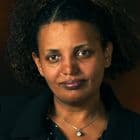
Interviews with Birtukan Midekssa
Ethiopia · Interviewed October 3, 2012
Politics in Ethiopia
When we had a regime change in 1991, we expected a shift in our political history.
Transcript
The current governing party came to power in 1991. And that era, in a way, was a defining moment in our political history, and those people who used to run and who are still running this party were engaged in armed struggle for 17 years, and they managed to topple a military junta who dictated the country for 17 years. So you know, obviously, they were freedom fighters, you know, they were promoting, you know, more freedom, equality and justice. And, of course, they might have a different ideological background, you know.
They were leftists and Marxist-Leninist, initially, especially in their establishment period, but when they came to power, that was not part of their narrative, partly because of the change in the international politics. So I was 12th grader by that time, but it was exciting for many of us. Why? For the first time, for people like me, we had a chance to listen to divergent political views. People from different political, you know, background would come and debate and we were able to watch, you know, in the public media. So that was fascinating.
That was, you know, entirely new phenomenon. And, of course, multiparty was recognized for the first time, and private press was allowed to operate. And, you know, people were able to publish all kinds of criticism and, you know, to watch the government policy and everything. In a way, it was kind of political renaissance. But, you know, it didn’t last long, you know. After introducing all these things, all ideas of political pluralism and everything, you know, the government, the ruling party, resorted to repression – repressing the political parties, persecuting the journalists.
So it was not the ideal of freedom and democracy was not something taken in a full heart. So from that time on, all the political process and the life of dissenting opinion and everything was full of persecution and repression. But, you know, in this kind of environment, people from the opposition, people from private press tried and managed to kind of survive and, you know, and sustain their voice. The time we had before, you know, this regime, definitely, it was a military dictatorship.
And, you know, it was an era of terror, in a way, from the very start. People, thousands of people were killed, tortured because of their political orientation by the military regime. So that was an era of terror. So when we had that regime change in 1991, we thought and we expected that that could be, you know, a shift in our political history, and that could – that could lead us to a full-fledged and, you know, to a real democratic life in our political community. Starting from 1991, a party called Ethiopian People’s Revolutionary Democratic Front, EPRDF, is in charge. And of course, the chairman of that party is Meles Zenawi. He’s also the prime minister of the country. No change at all – all the time.
About Birtukan Midekssa
Birtukan Midekssa is a former federal judge and leader of the pro-democracy opposition movement in Ethiopia.
Hailed as the Aung San Suu Kyi of her country, she was sentenced to life in prison in 2005 after her party, the Coalition for Unity and Democracy, won an unprecedented number of seats in parliamentary elections. After eighteen months in prison, she was pardoned in 2007 following a series of high-level negotiations. Upon her release, she founded the Unity for Democracy and Justice Party (UDJ) and was elected its first chairperson. In 2008, she was rearrested for allegedly having violated the terms of her pardon and remained in prison for almost two more years. In 2010, she was shortlisted for the European Parliament’s 2010 Sakharov Prize for Freedom of Thought.
Prior to entering politics, Ms. Midekssa served as a defense attorney and federal judge, rendering numerous court decisions in support of the rule of law and in defense of fundamental constitutional liberties. She drew the ire of the Ethiopian government when she presided as a judge in a high profile corruption case involving the former defense minister, Siye Abraha. Ms. Midekssa released Abraha for lack of evidence, but the government immediately rearrested him and sent him to jail for seven years. The government’s contempt for the rule of law helped motivate Birtukan Midekssa to become active in politics.
She was selected as a Reagan-Fascell Democracy Fellow for 2011-2012 at the National Endowment for Democracy and as a Scholar at Risk Fellow at the W.E.B. DuBois Institute at Harvard University for 2012 – 2013.