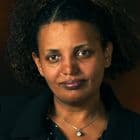
Interviews with Birtukan Midekssa
Ethiopia · Interviewed October 3, 2012
Arrested Again
They wanted me to recant what I said. I went back to prison.
Transcript
After we were released in 2007, you know, we encountered a different political environment, you know, from what we had in 2005. And our party was banned. You know, the party didn’t have any legal recognition. And our offices were closed, and you know, our members were scattered all over. So it was kind of a new start. So we reorganize ourselves, and we kind of – basically the party organized was a continuation of CUD [Coalition for Unity and Democracy], what we had in 2005. But we gave it a new name. We got registered as a new party. And we went through all legal processes we are supposed to, according to the electoral proclamation.
So we had our convention, and that convention elected me as a chairperson. And – but I served, like, for seven, eight months as a first person of the party. And this time around, I didn’t go through any trial. And what they said was – I was touring around in Europe. And I was conversing with our supporters about every kind of issues. And actually I was explaining, for example, about the release process, about our previous imprisonment time. And people were asking me whether we agreed to petition, you know, for pardon. And I explained everything to them, that the initial agreement was not to go through a pardon process, but the initial agreement was that the government would put an end to the court process immediately after we signed the document proposed by the elders of the country.
I just said this. This is the truth, I know. And that is – that could be attested by the elders, by the co-defendants, everybody. So when I immediately returned to the country, they said, she lied about the previous process in the statement she gave in Sweden, Stockholm. That was enough to re-arrest me and – re-arrest me and hear, you know, that you are supposed to stay for the whole your life, you know, just by revoking the pardon. As simple as that. And I had to stay in solitary confinement the first six months. And all those bad things happened. And the prison condition was entirely changed. You know, this time around it just became very horrible.
So yeah, but after 2010 election, obviously I’m rereleased again. My sense is, like, you know, it was all about the election we were supposed to have in 2010. Basically I was not wanted to be part of the process. What they wanted me to do is, like, to recant what I said in Europe and you know, admitting that I was lying and you know, I was just appealing to my supporters and I was appeasing them – all kinds of things. And they wanted to give some statement with that – you know, in that front. And I try to explain myself. I narrate what happened in all the process when I was – when we were in prison in 2005. And I narrate all the effort of the mediators and what happened finally and how – you know, how the agreement was pre-breached by the government. So I explained myself but that didn’t solve anything. And the pardon was revoked, and I was back to prison.
About Birtukan Midekssa
Birtukan Midekssa is a former federal judge and leader of the pro-democracy opposition movement in Ethiopia.
Hailed as the Aung San Suu Kyi of her country, she was sentenced to life in prison in 2005 after her party, the Coalition for Unity and Democracy, won an unprecedented number of seats in parliamentary elections. After eighteen months in prison, she was pardoned in 2007 following a series of high-level negotiations. Upon her release, she founded the Unity for Democracy and Justice Party (UDJ) and was elected its first chairperson. In 2008, she was rearrested for allegedly having violated the terms of her pardon and remained in prison for almost two more years. In 2010, she was shortlisted for the European Parliament’s 2010 Sakharov Prize for Freedom of Thought.
Prior to entering politics, Ms. Midekssa served as a defense attorney and federal judge, rendering numerous court decisions in support of the rule of law and in defense of fundamental constitutional liberties. She drew the ire of the Ethiopian government when she presided as a judge in a high profile corruption case involving the former defense minister, Siye Abraha. Ms. Midekssa released Abraha for lack of evidence, but the government immediately rearrested him and sent him to jail for seven years. The government’s contempt for the rule of law helped motivate Birtukan Midekssa to become active in politics.
She was selected as a Reagan-Fascell Democracy Fellow for 2011-2012 at the National Endowment for Democracy and as a Scholar at Risk Fellow at the W.E.B. DuBois Institute at Harvard University for 2012 – 2013.