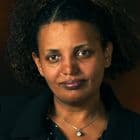
Interviews with Birtukan Midekssa
Ethiopia · Interviewed October 3, 2012
Judging the Defense Minister
I knew the political sensitivity, I knew the expectation of the government, I knew what I would do would have serious consequences for my future.
Transcript
So all my career life as a judge was full of challenges, you know. People might be aware of the case of [former Defense Minister] Siye [Abraha] because of, you know, his prominence in the political life of our country. Of course, he was the second person in the governing party, EPRDF [Ethiopian People’s Revolutionary Democratic Front]. But even before that, I handled so many cases, which had some kind of correlation with political activities and everything. So during – when I tried to handle all those cases according to the book and to the constitutional principles, I had challenge.
You know, I was under pressure from my boss, and even I have – couple of times, there were disciplinary cases instituted against me, just for implementing the law and the spirit of the law as it is. So to come to Siye’s case, you know, there was a split within the governing party. It was in the news – I was aware of it. And that split got its end by, you know, the prime minister got the upper hand at the end of the process, I think. But, you know, in a way, the prime minister and his supporters and colleagues didn’t want to leave the other group, you know, to live a free life.
So a lot of corruption cases were instituted before the courts. And, you know, the major case was, as said, the case of Siye and his family members. It was, in a way, funny, like six members of the family were imprisoned at the same time. And for me, those cases, of course, I knew the political sensitivity, I knew the expectation of the government, I knew what I would do would have a serious consequence about my professional career and my future in the institutions. But you know, I couldn’t have done it different, you know?
I didn’t have any choice other than entertaining it as any other ordinary case. That’s what’s expected from a judge, you know. So I tried to look into the facts collected by the police and the prosecution office. You know, it’s in a way embarrassing, in a way – this is a government, which introduced a constitutional way of organizing government and constitutional principles to talk to our political community. So as a preacher of those principles, as a preacher of independence of judiciary, that is – you know, that is not something that should be expected from that kind of regime.
But, you know, they didn’t go that way. And so repeatedly we tried – the court – my bench tried to implement the release warrant, but it didn’t happen. Finally, the arrested guy– Siye Abraha was supposed to appear before the court. And we explicitly told the officer that they don’t have any right to keep him under custody from that time on. Actually, we released him before the court, before the bench, right then and there. And but, you know, after some minutes, I finished my work and I wanted to go out for lunch. You know, it was, in a way, dramatic, you know? Siye Abraha was trying to get into his wife’s car. Of course, he’s told by a court of law, you know, by the institution of the country that he is free. So he was trying to exercise that right of freedom. And the police cars were almost trying to shoot at the tires of the car, you know.
It looks like a battlefield, not a courtyard. For me, that is a very frustrating and devastating experience, you know. That was not the thing I expected, you know. If they wanted him to arrest him again, they could have, you know – they could have, you know, implemented other measures, which might have some semblance of legality or, you know, some semblance of technical process, or something, you know. They didn’t defy the law like that, as if it doesn’t matter whatever the court of law says or whatever those institutions says.
What matters is the rule of – the political party or, you know, the rule of the prime minister. If that is the case, why did they bring him before the court of law from the very start? They could have put him, you know, under – in some corner of the country for long, you know, had it not been for the laws. If it is the case to be handled by the laws, they should show some kind of respect. It was disrespect, and it was more than that. So that was how it went, and in a way, that was a defining moment for me.
About Birtukan Midekssa
Birtukan Midekssa is a former federal judge and leader of the pro-democracy opposition movement in Ethiopia.
Hailed as the Aung San Suu Kyi of her country, she was sentenced to life in prison in 2005 after her party, the Coalition for Unity and Democracy, won an unprecedented number of seats in parliamentary elections. After eighteen months in prison, she was pardoned in 2007 following a series of high-level negotiations. Upon her release, she founded the Unity for Democracy and Justice Party (UDJ) and was elected its first chairperson. In 2008, she was rearrested for allegedly having violated the terms of her pardon and remained in prison for almost two more years. In 2010, she was shortlisted for the European Parliament’s 2010 Sakharov Prize for Freedom of Thought.
Prior to entering politics, Ms. Midekssa served as a defense attorney and federal judge, rendering numerous court decisions in support of the rule of law and in defense of fundamental constitutional liberties. She drew the ire of the Ethiopian government when she presided as a judge in a high profile corruption case involving the former defense minister, Siye Abraha. Ms. Midekssa released Abraha for lack of evidence, but the government immediately rearrested him and sent him to jail for seven years. The government’s contempt for the rule of law helped motivate Birtukan Midekssa to become active in politics.
She was selected as a Reagan-Fascell Democracy Fellow for 2011-2012 at the National Endowment for Democracy and as a Scholar at Risk Fellow at the W.E.B. DuBois Institute at Harvard University for 2012 – 2013.