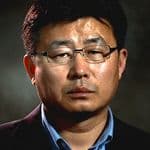
Interviews with Ahn Myeong Chul
North Korea · Interviewed August 4, 2014
Three Generations of Punishment
“He wanted to purge people who were against his will.”
Transcript
The existence of political prison camps is essential for maintenance of the [North Korean] regime.
Kim Il Sung created these camps. He wanted to purge people who were against his will.
[Kim Il Sung (1912 – 1994) was the founder and leader of the North Korean state from 1948 until his death in 1994.]
In Kim Il Sung’s doctrine he stated that three generations will be punished for political crimes.
Not your extended family, but the immediate members of your family, meaning your grandfather’s generation, your father’s generation, and your son’s generation. These three generations would be punished.
First, a crime is investigated. If there is any evidence that a person has gone against the system, then the punishment is decided. An individual may or may not have a trial in court.
If you were involved in a very serious crime, you might face a death sentence. As for your family, if a member of your family has engaged in a political crime, a truck comes in the middle of the night and sweeps every family member away from their home. You are then taken to a prison camp.
The family members have no trial, so the family members are suddenly in a prison camp without knowing why. Only after entering the prison camp do you learn what “sin” your family member committed. Then you realize that you also must pay.
If you look at the structure of prison camps in North Korea, there are two kinds of prison camps: one is for economic perpetrators and the other is for political criminals. Regular police are in charge of economic criminals whereas the Ministry of State Security is in charge of political violators. When I say political violators, I’m referring to people who have engaged in some kind of action against or expressed opposition to the North Korean authorities.
There are also two types of areas in prison camps: one that accommodates the perpetrators themselves and another for the perpetrators’ relatives. The prison camp where I worked was for the families.
About Ahn Myeong Chul
Ahn Myeong Chul was born in North Hamgyong Province in North Korea. As a teenager, he was the only person from his province selected to serve as a political prison camp guard. Ahn worked in several camps for a period of eight years where he was brainwashed into believing that political prisoners were enemies of the state unworthy of sympathy. As many as 130,000 men, women and children are imprisoned in North Korea’s vast system of gulags.
Although Ahn witnessed executions, starving children, and extreme torture, it was not until he became a prison truck driver that he questioned the system. Ahn would converse with prisoners he transported and was astonished to learn they knew nothing about the reasons for their imprisonment. It was his introduction to the country’s system of “guilt-by-association” punishment; in North Korea, whole families are incarcerated for the offenses of a single family member.
While on leave in 1994, Ahn learned that his father, a member of the ruling Workers’ Party, had committed suicide after questioning the regime’s rationing system. Ahn’s mother and siblings were imprisoned for his father’s offenses. Fearing that authorities would come for him, he fled to China and eventually reached safety in South Korea.
Since his escape, Ahn has become a North Korean human rights activist. He has provided testimony at the United Nations Commission of Inquiry on Human Rights in the Democratic People’s Republic of Korea (North Korea) and is now the secretary general of the organization Free NK Gulag.