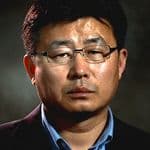
Interviews with Ahn Myeong Chul
North Korea · Interviewed August 4, 2014
Brainwashing and Indoctrination
If you say anything bad about Kim Il Sung, you can be killed on the spot.”
Transcript
The moment you joined the prison camp guards, you were constantly indoctrinated that the prisoners in these camps are traitors and enemies.
If they attempt to flee or disobey, then you are allowed to shoot and kill them. If you happen to capture an escapee, then they will send you to university.
To avoid developing any kind of sympathy towards these people, you cannot do any favors for them at all or listen to their requests. If that happens, then you and your family will become political prisoners.
We were constantly told that these prisoners are our enemies, and that they opposed our great leader, Kim Il Sung. I was always warned that I would be killed I if did a poor job on my duties.
[Kim Il Sung (1912 – 1994) was the founder and leader of the North Korean state from 1948 until his death in 1994.]
When you join the prison guards you have to work [at a camp] for 10 years. Thanks to the first three years of indoctrination, guards like me would view these prisoners as really bad people and we would treat them badly.
Then you start to spend a lot of time with them. I witnessed some guards develop sympathy [towards prisoners] and treat them like human beings.
But even so, they wouldn’t say anything for fear of punishment.
During my first three years as a prison guard, I worked outside the prison camps, so I thought that the prisoners were really bad people.
Later I was selected to work as a driver and would meet prisoners on a daily basis. Sometimes, I would ask them where they were from and why they were here.
I was shocked to find out that a lot of them had no idea. They would tell me that they were just sleeping one night and a truck came and brought their entire family here.
Later, they were told that their grandfather, whom they have never met, did something wrong and so they had to pay the price.
This confused me a great deal, and after going through the same experience with my family members I had an awakening.
This was one of the motivations behind my decision to leave.
When I was in North Korea, I was constantly told that South Korea was a colony of the United States. I was told it was extremely poor and had so many beggars.
I was also told that if I were to defect to the south, the South Korean government would extract all my secrets, gouge out my eyes, and kill me on the spot.
I was very, very nervous when I entered into South Korea – only to find that the treatment that the government gave me was quite the opposite.
Because I had been working as a prison camp guard, I had little understanding of how developed South Korea’s economy was…
But what most shocked me the most was the fact that South Koreans openly denounced and criticized politicians and even their president. I had a very hard time adjusting to that. In North Korea, if you say anything bad about the great leader Kim Il Sung, you can be killed on the spot.
[Kim Il Sung (1912 – 1994) was the founder and leader of the North Korean state from 1948 until his death in 1994.]
Even to this day, I have a hard time openly denouncing or criticizing the current [South] Korean president. That’s how brainwashed I was.
About Ahn Myeong Chul
Ahn Myeong Chul was born in North Hamgyong Province in North Korea. As a teenager, he was the only person from his province selected to serve as a political prison camp guard. Ahn worked in several camps for a period of eight years where he was brainwashed into believing that political prisoners were enemies of the state unworthy of sympathy. As many as 130,000 men, women and children are imprisoned in North Korea’s vast system of gulags.
Although Ahn witnessed executions, starving children, and extreme torture, it was not until he became a prison truck driver that he questioned the system. Ahn would converse with prisoners he transported and was astonished to learn they knew nothing about the reasons for their imprisonment. It was his introduction to the country’s system of “guilt-by-association” punishment; in North Korea, whole families are incarcerated for the offenses of a single family member.
While on leave in 1994, Ahn learned that his father, a member of the ruling Workers’ Party, had committed suicide after questioning the regime’s rationing system. Ahn’s mother and siblings were imprisoned for his father’s offenses. Fearing that authorities would come for him, he fled to China and eventually reached safety in South Korea.
Since his escape, Ahn has become a North Korean human rights activist. He has provided testimony at the United Nations Commission of Inquiry on Human Rights in the Democratic People’s Republic of Korea (North Korea) and is now the secretary general of the organization Free NK Gulag.