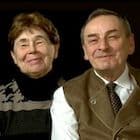
Interviews with Zbigniew and Zofia Romaszewski
Poland
Martial Law
“If this had been a normal country, they would not have been in prison.”
Transcript
MR. ROMASZEWSKI: Everyone stopped smiling, is what I would say about that [after martial law was declared in Poland from December 1981-July 1983 by the military government of General Wojciech Jaruzelski. It was an attempt to crush political opposition; thousands of opposition activists were jailed without being charged.]. The country was in an extremely grim mood. However, we might not be the best witnesses to ask because we were simply in hiding, both of us, throughout martial law. We simply got lucky in that regard. For myself, I did not participate, that time, in the [session of the] National Committee of Solidarity [the governing body of Solidarity, a labor union formed by Gdansk ship builders that transformed into a nationwide resistance movement], and to that I attribute not getting arrested.
My wife as well, she stepped out just before the end of someone’s Name Day party [a tradition in many European and Latin American countries celebrating the day associated with a person’s name, typically a Christian saint’s feast day]– for Alexandra – out of which everyone was arrested, so in that way, we really were somewhat lucky. And from that point on, we went into hiding, simply put.
MS. ROMASZEWSKA: For myself, I have to add that throughout the entire period of Solidarity’s existence, I did not for one moment – and I was a fully grown person at the time, and for instance – we were both constantly very aware of this subterranean war that was being waged. Because I was employed at the Intervention Assistance Committee of Solidarity. So this was everywhere, at every turn, there was a war being waged against the communist regime. As blows went tit-for-tat, tit-for-tat, tit-for-tat – and like that. So because everything was ultimately still in the hands of the communists, so, let us see, no, we did not expect or predict anything specific. We just thought we ought to continue waging this struggle for our rights. I think also, to say this was a shock and came completely out of the blue – for me: no, it was not that way. A very sad thing, but it was not astonishing.
MR. ROMASZEWSKI: The best proof to give you, that apart from this grand festive atmosphere of a carnival [in the time between Solidarity’s creation and the declaration of martial law], I always carried on me a set of keys to an apartment of one of my friends. In case things started happening – just to have a place to go hide in. And this was exactly what I did on the first day, being December 13 [1981] in the morning. So straight off the train, I stepped into my friend’s apartment to hide away. And of course our apartment was raided, they arrested our daughter, they arrested our future son-in-law, and these two were interned.
MS. ROMASZEWSKA: But also, which needs adding, during the time of Solidarity, our friends from the Konfederacja Polski Niepodległej [KPN] were spending time in prison. I remember very clearly how much trouble we put into collecting signatures, signatures were being collected very much like they are these days – to no avail. We tried to have them be – well, the people who were in jail were a group from the KPN. So none of that was normal, really – if this had been a normal country, they would not have been in prison [KPN, or in English, The Confederation of Independent Poland was the first independent political party in the Eastern bloc countries. Founded in 1979, the party was not recognized by Poland’s communist government and many of its leaders and activists were arrested.].
MR. ROMASZEWSKI: But this was still not the worst conceivable atmosphere. I need to add that at the time when we started building our underground society, throughout that time I had a strong feeling that I could have walked into anybody´s home, and they would have stowed me away, any one of them.
About Zbigniew and Zofia Romaszewski
Zbigniew Romaszewski and his wife, Zofia Romaszewska, were born in 1940 in Warsaw, Poland. Growing up during World War II and the Soviet Union’s subjugation of Eastern Europe, the couple became opponents of Poland’s communist regime and activists in various democratic opposition movements.
As children, Zbigniew and Zofia witnessed the horrors of World War II. Zbigniew and his family were sent to concentration camps, where his father died. After the war, he was raised by his mother and aunt. Zofia’s parents were part of Poland’s Home Army, an underground resistance movement against the Nazi occupation.
Zbigniew and Zofia both studied physics at the University of Warsaw. In the 1970s, following protests over rising prices by workers in the cities of Radom and Ursus, they helped to create the Workers’ Defense Committee (KOR), an organization that provided monetary and material support to persecuted laborers and their families. In addition, KOR documented human rights violations committed by the regime. Zbigniew also served as a principal editor for the Madrid Report, a detailed account of human rights violations in Poland that was released during the 1980 review meeting of the Organization for Security and Cooperation in Europe (then known as the Conference on Security and Cooperation in Europe).
In 1980, worker strikes at Gdansk’s Lenin Shipyard led to the formation of Solidarity, the first independent labor union in the communist world. The movement inspired millions within Poland and transformed into a nationwide freedom movement. Zbigniew and Zofia joined Solidarity and became active members. In December 1981, the government declared martial law in an effort to crackdown on political opposition. During this time the Romaszewskis went into hiding and established Radio Solidarity, an underground radio station that broadcast independent news and information to Polish citizens until the communist regime fell.
In communism’s final days, Zbigniew was elected to the Senate as an independent candidate in the semi-free elections of 1989. The next year, Lech Walesa was elected as the country’s first post-communist president and the first fully free parliamentary elections were held in 1991. Zbigniew served in the Polish Senate through much of the following two decades, including as the deputy speaker from 2007 – 2011.
Zbigniew Romaszewski passed away on February 13, 2014.