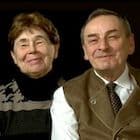
Interviews with Zbigniew and Zofia Romaszewski
Poland
1976 Uprisings
The Romaszewskis remember government brutality in suppressing the 1976 worker strikes.
Transcript
MR. ROMASZEWSKI: Well, at this very moment repression began [June 1976], and rather drastic repression – seeing as this was a broad-based strike which erupted in Ursus [a suburb of Warsaw], in Radom, Plock, Grudziadz [Polish cities] – the greatest intensity was in Ursus and Radom. These two demonstrations were disparate in nature. In the case of Ursus – you had a classic worker strike – since this was a large [agricultural machinery] plant employing about 20,000 people. So they stepped out. And their plant was located in [a fork between] two railway lines. So they stepped out, they blockaded the rail lines, and that is how any information about the strike even circulated around Poland. At any rate this was, I would say, sufficiently organized, to the extent that people from a single production plant were located in one place. So that was one strike.
On the other hand, in Radom, the difference was that here people walked out into the streets, there was a large demonstration, there was rioting, the Provincial Committee of the Communist Party was set on fire. And, well, the rioting began – incidentally, I think that from the very outset, the authorities conceived that these actions have to be stopped, because the major streets in the city were now filled by these very strange pickets breaking storefront windows and the police were doing absolutely nothing about it. So the objective was to show up the worker protest in Radom. This had its reflection later on during the trials as well.
MS. ROMASZEWSKA: Say this was a provocation.
MR. ROMASZEWSKI: So this was a provocation of sorts. And of course the arrest that took place after this were sweeping. And I think that in the first days following the arrests had to include, I guess, 2,000 or 3,000 people – both in Ursus, and in Radom. And, I do not think there were any direct fatalities resulting.
On the other hand, those who were detained got subjected to this astonishing medieval, or perhaps 19th century technique – what I mean is, they would pass these people between two lines of policemen – there were 50 or 60 – who each struck these people with batons. They simply beat them with batons.
So then afterwards, what happened there were supposedly – supposed trials. And the situation was that there were virtually two kinds of law – the criminal court process in cases which were charged, as well as the magistrates, courts for misdemeanors. And a telling example here was this, when one of these people who were passed between the lines of truncheon-wielding policemen, they called these “the workout trail,” was so badly mauled that his legs had swollen so badly he was unable to put on his pants – but he was among those who were supposed to stand in the dock in criminal court – there to hear his sentence of two, three or five years in prison, right? But this man could not put on his pants. So they switched things around. They took another group – people who were supposed to stand up in court, and switched it with the group that was supposed to go to the misdemeanor magistrate to only get their three months, and the misdemeanor group heard criminal sentences – and that is how things were “resolved.”
This is how justice was performed.
Oh, those people headed for the Magistrate were going to go later on, so he had time to get those pants on. So there you have the justice system in a nutshell.
About Zbigniew and Zofia Romaszewski
Zbigniew Romaszewski and his wife, Zofia Romaszewska, were born in 1940 in Warsaw, Poland. Growing up during World War II and the Soviet Union’s subjugation of Eastern Europe, the couple became opponents of Poland’s communist regime and activists in various democratic opposition movements.
As children, Zbigniew and Zofia witnessed the horrors of World War II. Zbigniew and his family were sent to concentration camps, where his father died. After the war, he was raised by his mother and aunt. Zofia’s parents were part of Poland’s Home Army, an underground resistance movement against the Nazi occupation.
Zbigniew and Zofia both studied physics at the University of Warsaw. In the 1970s, following protests over rising prices by workers in the cities of Radom and Ursus, they helped to create the Workers’ Defense Committee (KOR), an organization that provided monetary and material support to persecuted laborers and their families. In addition, KOR documented human rights violations committed by the regime. Zbigniew also served as a principal editor for the Madrid Report, a detailed account of human rights violations in Poland that was released during the 1980 review meeting of the Organization for Security and Cooperation in Europe (then known as the Conference on Security and Cooperation in Europe).
In 1980, worker strikes at Gdansk’s Lenin Shipyard led to the formation of Solidarity, the first independent labor union in the communist world. The movement inspired millions within Poland and transformed into a nationwide freedom movement. Zbigniew and Zofia joined Solidarity and became active members. In December 1981, the government declared martial law in an effort to crackdown on political opposition. During this time the Romaszewskis went into hiding and established Radio Solidarity, an underground radio station that broadcast independent news and information to Polish citizens until the communist regime fell.
In communism’s final days, Zbigniew was elected to the Senate as an independent candidate in the semi-free elections of 1989. The next year, Lech Walesa was elected as the country’s first post-communist president and the first fully free parliamentary elections were held in 1991. Zbigniew served in the Polish Senate through much of the following two decades, including as the deputy speaker from 2007 – 2011.
Zbigniew Romaszewski passed away on February 13, 2014.