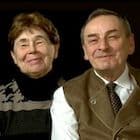
Interviews with Zbigniew and Zofia Romaszewski
Poland
Background
The Romaszewskis discuss early experiences in their struggle for human freedom.
Transcript
ZOFIA ROMASZEWSKA: Well my biography is not all that complicated. I was born in Warsaw, a very long time ago [1940]. My interests are in the population, interest in people in general, their history and their living conditions, I primarily inherited this from my birth home, simply put. A home in which there was always this interest. My mom was in the Home Army [an underground resistance movement organized against the Nazi occupation of Poland], so was my dad, and therefore – my grandparents also fought for our country, for its improvement – and therefore such traditions were just always present in our home.
ZBIGNIEW ROMASZEWSKI: Well, in my case there may be a greater abundance, so to speak, because everything seems to begin and end with the Warsaw Uprising [The Warsaw Uprising was an unsuccessful but heroic military campaign in 1944 by the Polish Home Army during World War II against Nazi occupation forces.]. What I mean is that my family, to a large extent, ceased to exist at that time. My father was murdered in Sachsenhausen [Nazi concentration camp in Oranienburg, Germany], my grandmother was murdered at Ravensbruck [Nazi concentration camp for women and children in Ravensbruk, Germany]. And of the entire family only myself and one aunt survived [and his mother].
I myself also spent time at a German camp – this was Ravensbruck – and later in a labor camp. And it was only [General] George Patton´s army which liberated me in Germany [George Patton was a general in the United States Army who commanded the Seventh United States Army, and later the Third United States Army, in Europe during World War II].
And in this way I was practically raised by two women – my mother stood in for my father, my aunt stood in for my mother, and in this way I entered into the years of Stalinism [referring to the totalitarian rule of Joseph Stalin, who led the Soviet Union from 1922-1952]. And really from the very outset, I knew lots and lots of things which I should not have known about. [02:38:05] I knew about the Katyn Forest massacre [a mass execution of Polish nationals carried out by the People´s Commissariat for Internal Affairs (the Soviet secret police) in1940], I knew about the arrests that took place among Polish intelligentsia when the communist system was being introduced – all this information cycled through our home.
This was a very difficult time, and I must give credit to my mom, who had lots of toughness. My mother was an accountant and she worked at the Internal Audits [department] of the National Bank of Poland. And at a juncture when she was ordered to snoop in the desk drawers of her colleagues, she told them: “no,” she would do no such thing. And that was the point at which they threw her out to work at the postal desk, where she would stamp incoming mail. She sat at that desk until 1956, and after that she went back to a regular banking position.
So this kind of atmosphere was why I wanted to have something stable in my life, and so at the University [of Warsaw] I decided to study physics.
I always had an interest in the law, but after all those abuses of the law under the Stalinist system and all the related unpleasantness, the law was really not something to think about, rather something to run away from and go for something more verifiable, so to speak – so I became a physicist. I got my doctorate.
But, nevertheless, throughout that time in our home – not even in our home, but in general, we had interests of a political nature, of a social nature. I met my wife in the year 1957, that January, probably the 7th or 8th – this was during the winter recess. We met at an event which was organized by the first free – well, almost free – newspaper called Po Prostu [Straight Out] – it organized a youth conference which they called a “Revolutionary Youth Congress”.
Oh, we were revolutionary youth, all right – both my wife and myself – because as it happened in our respective schools we had disbanded the cells of the [Communist] Polish Union of Youth (ZMP). And somehow things have stayed in that fashion, and ever since then we have stuck with each other and gone through life together.
About Zbigniew and Zofia Romaszewski
Zbigniew Romaszewski and his wife, Zofia Romaszewska, were born in 1940 in Warsaw, Poland. Growing up during World War II and the Soviet Union’s subjugation of Eastern Europe, the couple became opponents of Poland’s communist regime and activists in various democratic opposition movements.
As children, Zbigniew and Zofia witnessed the horrors of World War II. Zbigniew and his family were sent to concentration camps, where his father died. After the war, he was raised by his mother and aunt. Zofia’s parents were part of Poland’s Home Army, an underground resistance movement against the Nazi occupation.
Zbigniew and Zofia both studied physics at the University of Warsaw. In the 1970s, following protests over rising prices by workers in the cities of Radom and Ursus, they helped to create the Workers’ Defense Committee (KOR), an organization that provided monetary and material support to persecuted laborers and their families. In addition, KOR documented human rights violations committed by the regime. Zbigniew also served as a principal editor for the Madrid Report, a detailed account of human rights violations in Poland that was released during the 1980 review meeting of the Organization for Security and Cooperation in Europe (then known as the Conference on Security and Cooperation in Europe).
In 1980, worker strikes at Gdansk’s Lenin Shipyard led to the formation of Solidarity, the first independent labor union in the communist world. The movement inspired millions within Poland and transformed into a nationwide freedom movement. Zbigniew and Zofia joined Solidarity and became active members. In December 1981, the government declared martial law in an effort to crackdown on political opposition. During this time the Romaszewskis went into hiding and established Radio Solidarity, an underground radio station that broadcast independent news and information to Polish citizens until the communist regime fell.
In communism’s final days, Zbigniew was elected to the Senate as an independent candidate in the semi-free elections of 1989. The next year, Lech Walesa was elected as the country’s first post-communist president and the first fully free parliamentary elections were held in 1991. Zbigniew served in the Polish Senate through much of the following two decades, including as the deputy speaker from 2007 – 2011.
Zbigniew Romaszewski passed away on February 13, 2014.