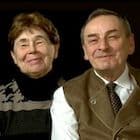
Interviews with Zbigniew and Zofia Romaszewski
Poland
All for One, One for All
“People come together whenever everyone is fed up with a specific thing.”
Transcript
MS. ROMASZEWSKA: I think people come together whenever a historical moment arises, in which everyone at the same time is fed up with a specific thing, and is thinking along the same lines – when fairly large groups of people begin to think the same thoughts. In this instance, it was plain as day that the communists had horrendously beaten to a pulp these people, especially in Radom, perhaps to a greater extent than in Ursus [Radom and Ursus were locations of the most intense 1976 protests against rising prices in Poland]. And that they had absolutely unthinkable nerve to be still talking about the workers and peasants as holding political power in our country. So I think at the same time everyone just reached that conclusion. And there are always a few groups who are more invested, are more interested in public and political life.
And I think that those young people who at the time were members of the clubs of Catholic intelligentsia, because these were primarily with whom we collaborated, and who traveled with us to Radom, they decided that after classes or whatever, you know, people would come to the homes of those families where somebody was in jail, and bring them assistance. The way the assistance was arranged, or an attorney, or if they had traveled to Warsaw we would arrange for a place where they could stay, help them do errands – would take them to appointments with an attorney, you would arrange for some direct assistance to the families themselves, we would even bring clothing for the children, someone would buy some things for them. We had no inkling how dire the poverty was in the city of Radom, it was absolutely incredible.
MR. ROMASZEWSKI: Material aid – very important.
MS. ROMASZEWSKA: Exactly, material aid was critically important.
MS. ROMASZEWSKA: You know, any movement can become organized and be effective when it has some form of protection. What I mean is, when people are able to organize in such a way, where there is a component of empathetic solidarity, protection, and where people know that, so to speak it is one for all and all for one – that you yourself would go to prison for another – that is very important.
About Zbigniew and Zofia Romaszewski
Zbigniew Romaszewski and his wife, Zofia Romaszewska, were born in 1940 in Warsaw, Poland. Growing up during World War II and the Soviet Union’s subjugation of Eastern Europe, the couple became opponents of Poland’s communist regime and activists in various democratic opposition movements.
As children, Zbigniew and Zofia witnessed the horrors of World War II. Zbigniew and his family were sent to concentration camps, where his father died. After the war, he was raised by his mother and aunt. Zofia’s parents were part of Poland’s Home Army, an underground resistance movement against the Nazi occupation.
Zbigniew and Zofia both studied physics at the University of Warsaw. In the 1970s, following protests over rising prices by workers in the cities of Radom and Ursus, they helped to create the Workers’ Defense Committee (KOR), an organization that provided monetary and material support to persecuted laborers and their families. In addition, KOR documented human rights violations committed by the regime. Zbigniew also served as a principal editor for the Madrid Report, a detailed account of human rights violations in Poland that was released during the 1980 review meeting of the Organization for Security and Cooperation in Europe (then known as the Conference on Security and Cooperation in Europe).
In 1980, worker strikes at Gdansk’s Lenin Shipyard led to the formation of Solidarity, the first independent labor union in the communist world. The movement inspired millions within Poland and transformed into a nationwide freedom movement. Zbigniew and Zofia joined Solidarity and became active members. In December 1981, the government declared martial law in an effort to crackdown on political opposition. During this time the Romaszewskis went into hiding and established Radio Solidarity, an underground radio station that broadcast independent news and information to Polish citizens until the communist regime fell.
In communism’s final days, Zbigniew was elected to the Senate as an independent candidate in the semi-free elections of 1989. The next year, Lech Walesa was elected as the country’s first post-communist president and the first fully free parliamentary elections were held in 1991. Zbigniew served in the Polish Senate through much of the following two decades, including as the deputy speaker from 2007 – 2011.
Zbigniew Romaszewski passed away on February 13, 2014.