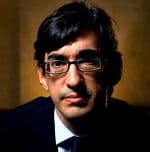
Interviews with Ernesto Hernandez Busto
Cuba · Interviewed January 5, 2011
Background
Ernesto Hernandez Busto discusses his background
Transcript
I started ties with this, what we could call a dissident movement, about six years ago, but I actually started blogging about Cuban issues, and getting involved in a much more serious way, four years ago. I have lived outside of Cuba for a long time. First, I lived nine years in Mexico, where I began my intellectual career, trying to work as an essayist, editor, always related to the intellectual world, and then, when I arrived in Spain ten years ago, I started working as an editor and translator, but I always kept connected, so to speak, to the opposition movements in Cuba.
Because in the 80´s, right when I left Cuba, in the late 80´s, there had been something like a generational illusion about change among a number of intellectuals and artists who believed it was possible to make a change within Cuban society. Those expectations of change were completely defrauded in the 80´s, which generated a mass exile. I think that´s an important fact to keep in mind: many of today´s most important intellectuals in exile are people who left Cuba in the 80´s, when they realized that it was impossible to lead a normal, uncensored intellectual life, free from elements that are inherent to Cuban society or the Cuban regime. So I think we were left with a kind of sense of guilt, and then the emergence of people like Yoani Sanchez [Yoani Sanchez is a Cuban journalist and blogger. She is well known for her critical reporting of the regime and conditions in the country.], and a group of young people, just a few years ago, gave us back some of that hope. And in that sense, at least for me personally, it was a real shock to discover that a generation of people who are now in their twenties, could connect with people of my generation who wanted to do something many years ago and with people who have been in exile for a very long time. I think one of the key features of this protest movement, or this movement of discontented younger people, is that they have created a new relationship with the exile community.
Traditional dissident movements in Cuba have been trying for many years to make their demands visible, fair demands without a doubt, demands that have been suppressed for obvious reasons; I believe that in the past, it would not have been possible to connect with exiles in such a way. The dissident in Cuba would not have been able to generate an international reaction, and at the same time, would not have been able to connect with exiles in the same way. So I think the fact that now there are people from a new generation, people from a “new phase,” so to speak, of the protest movements, linked to the new technologies, has created an important effect. A turning point, I think.
About Ernesto Hernandez Busto
Ernesto Hernández Busto is an essayist, journalist and blogger and a recognized authority on technology and democracy. He was born in Havana, Cuba in 1968.
As a young man, he became active in the Paideia movement, a group of artists and writers that sought to reform cultural policy in Cuba. The response of security forces to this group of young intellectuals influenced his decision to emigrate. At the age of 21, he left Cuba “to escape the oppressive atmosphere of a totalitarian society, which was suffocating in all areas of life.”
From 1992 to 1999, he lived in Mexico, where we wrote for Vuelta magazine, edited by Octavio Paz, as well as other literary journals and publications. Since 1999, he has lived in Barcelona, Spain, where he works as an editor, translator and journalist.
His books include ‘Perfiles derechos. Fisonomías del escritor reaccionario’ (Barcelona, 2004; III “Casa de América” essay prize) and ‘Inventario de saldos. Apuntes sobre literatura cubana’ (Madrid, 2005). He has also published literary translations from Italian, Russian, French and Portuguese.
Since 2006, he has edited and published Penúltimos Días (www.penultimosdias.com), one of the most important websites on Cuban issues, with more than 70 contributors in 12 countries and over 10 million page views. He has participated in various forums on digital activism as “Internet at Liberty 2010” (organized by Google and the European Central University) and “Personal Democracy Forum Latin America,” among others. His blog is widely recognized as among the most authoritative and comprehensive websites covering events in Cuba.
He wrote the chapters on Cuba’s for Freedom House’s “Freedom on the Net” report (2010 and 2011). He is a frequent contributor to the Spanish newspaper El País, on policy and technology.
Read his blog at www.penultimosdias.com and follow him on Twitter: @penultimosdias