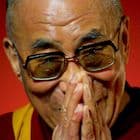
Interviews with Dalai Lama
China
Tibetan Reform
The political institution and the religious institution must be separate.
Transcript
Tibetan spirit, very much link with Buddhist faith. Like Polish spirit – you see, they [had] different difficult circumstances during Nazi occupation and during Soviet occupation, a lot of difficulties. But, during these periods, the Polish national spirit and Catholic faith combine, keep their spirit. In many case exactly the same. National interest and Buddhist faith combine.
Then one advantage here: now in China proper, the number of Buddhists rapidly increasing. Many of these Chinese Buddhists are also showing interest about Tibetan Buddhism. Now, for example, in India and some other different places, the Chinese – mainly Chinese – Buddhists from Mainland China always coming to see me. Came to see me. Even with difficulties, they are very, very eager come outside and to see me.
That is part of the process of democratization, you know? If I carry this main responsibility, then sometimes I feel it might be hindrance the people, free expression or criticism, because, you see, I not only political leader but also spiritual leader. And then, also, I always have this sort of strong view. The political institution and religious institution must be separate. I always was telling other people.
So while I’m telling other people the political institution, the spiritual institution be separate, then I myself combined. So my expression looks not very sincere or hypocrisy. So therefore, after 10 years now, elected political leadership already there. My position, semi-retired position. Then, I thought, now right time.
Sooner or later, there will be a day without a Dalai Lama, actually. That, sooner or later, will come. So the people must prepare. So much better while I alive. They carry full responsibility. In case my help needed, I’m available.
And then, also, the four-century-old, this tradition actually out of date, must change. They change due to some other pressure, and that’s not good. I think change – this four-century-old tradition must end. This is old fashioned, must end. So it is much better that this change by Dalai Lama himself voluntarily, happily, proudly end that. I feel that is anyway serving two previous Dalai Lamas and Dalai Lama institution itself. I feel like that.
So now I return there only for spiritual field. So of course, there’s no point to resign from Dalai Lama. This is not elected, but through – through – mysteriously, I become Dalai Lama. So until my death, I am the Dalai Lama. So okay.
About Dalai Lama
His Holiness the 14th Dalai Lama, Tenzin Gyatso, is the spiritual leader of Tibetan Buddhism and, for a time, led the government of Tibet in exile.
His Holiness was born July 6, 1935, to a farming family in northeastern Tibet. He was identified as the reincarnation of the 13th Dalai Lama, Thubten Gyatso, when he was three years old and was raised in Lhasa, Tibet, where he was educated in topics such as Buddhist philosophy, logic, Tibetan art and culture, and medicine in preparation for his responsibilities as the Dalai Lama.
In 1949, at age 15, His Holiness assumed responsibility as the political leader of Tibet. Later that year, the People’s Republic of China invaded Tibet. In 1959, as Chinese troops suppressed a Tibetan uprising in Lhasa, His Holiness was forced into exile and has since lived in Dharamsala, India, the seat of the Tibetan political administration in exile.
His Holiness has worked to establish a democratic government in exile. The Charter of Tibetans in Exile grants freedom of speech, belief, and assembly. In 2001, His Holiness ceded his absolute power over the government to an elected parliament. He has recently ceded any role in the government because of his view that spiritual and political authorities should be divided.
In 1989 His Holiness was awarded the Nobel Peace Prize. In announcing the award, the Nobel Committee recognized that “the Dalai Lama . . . consistently has opposed the use of violence. He has instead advocated peaceful solutions based upon tolerance and mutual respect in order to preserve the historical and cultural heritage of his people.”