Interviews with Dalai Lama
China
Background on Tibet's Oppression
Describing the development of his support for a democratic system for Tibet.
Transcript
Briefly, I should explain about the whole background. When I was young, I think age 13, 14, but not yet taken responsibility or political responsibility, there was a regent – infant regent was my own sort of teacher. In spite of deep respect as a teacher, but I heard a lot of criticisms about this regent. And then I already noticed the system itself, you see, there are some sort of drawbacks.
Then age 16, I took the – I had the responsibility for the political aspect. Then, of course, in spite – beside difficulties dealing with Chinese, I already start some reform. So I set up one reform committee and started some reform. But not very successful because the Chinese side, you see, they want reform according to their own sort of style. So if Tibetan reform was to carry, then that might become a hindrance in their own introduced reform like that.
So then, after then, 1954, I went to China. I participated at the People’s Congress there. In fact, I am one of the member of the Tibetan delegation. Then 1956, I came to India on one Buddhist celebration. I invited by Indian government, so I went there. Then, I also, you see, was to observe Indian Parliament. I found big contrast. The Chinese Parliament, very much disciplined. The Indian Parliament looks as no discipline, too much noisy. And the members very proudly criticized about their leaders, their government. So I was very much impressed. Very much impressed.
So then 1959, after we came to India – of course, it’s traditionally the venerable Dalai Lama and the Dalai Lama’s cabinet there, the Tibetan government there, like that. This is not a newly established, but simply myself and a few cabinet ministers with me when we escape from Tibet.
But then 1959 April, we reach India. We already – then, at once, we start some change. Not like previous sort of system, but more divisions among the cabinet ministers. So then, 1960, we start work for democratization.
About Dalai Lama
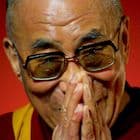
His Holiness the 14th Dalai Lama, Tenzin Gyatso, is the spiritual leader of Tibetan Buddhism and, for a time, led the government of Tibet in exile.
His Holiness was born July 6, 1935, to a farming family in northeastern Tibet. He was identified as the reincarnation of the 13th Dalai Lama, Thubten Gyatso, when he was three years old and was raised in Lhasa, Tibet, where he was educated in topics such as Buddhist philosophy, logic, Tibetan art and culture, and medicine in preparation for his responsibilities as the Dalai Lama.
In 1949, at age 15, His Holiness assumed responsibility as the political leader of Tibet. Later that year, the People’s Republic of China invaded Tibet. In 1959, as Chinese troops suppressed a Tibetan uprising in Lhasa, His Holiness was forced into exile and has since lived in Dharamsala, India, the seat of the Tibetan political administration in exile.
His Holiness has worked to establish a democratic government in exile. The Charter of Tibetans in Exile grants freedom of speech, belief, and assembly. In 2001, His Holiness ceded his absolute power over the government to an elected parliament. He has recently ceded any role in the government because of his view that spiritual and political authorities should be divided.
In 1989 His Holiness was awarded the Nobel Peace Prize. In announcing the award, the Nobel Committee recognized that “the Dalai Lama . . . consistently has opposed the use of violence. He has instead advocated peaceful solutions based upon tolerance and mutual respect in order to preserve the historical and cultural heritage of his people.”