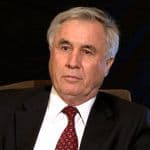
Interviews with Álvaro Varela Walker
Chile
Pinochet's Reign of Terror Begins
“1972 and 1973 were a period of great unrest in Chile”
Transcript
Without a doubt, the years 1972 and 1973 were a period of great unrest in Chile, of great political confrontation, distinctly different from normal politics.
It was different from what had happened in Chile’s history. And all of the political groups, I think, and all of us who were in politics had a belligerent attitude.
Things became more extreme and we were in a black or white role. Either you belonged to one side or the other. They were absolutely irreconcilable. This was reinforced when the Catholic Church Cardinal, Raúl Silva Henríquez, around mid-1973, attempts to establish talks between the government and the opposition without result.
[Raúl Silva Henríquez, (1907 –1999) was a Chilean Cardinal of the Catholic Church.]
And later with the resignation of the Commander in Chief of the Army, General Carlos Prats, in August 1973.
[General Carlos Prats (1915 –1974) was a Chilean Army officer, a political figure, minister and Vice President of Chile during President Salvador Allende´s government, and commander-in-chief of the Chilean Army.]
But in spite of those extreme circumstances, never would anyone have imagined that a group of citizens, in this case mainly the Armed Forces, led by the Army and the man named Commander in Chief by President Dr. Salvador Allende, would have behaved in such an inhumane and atrocious manner against an important part of the population.
[Salvador Allende (1908-1973) was president of Chile between 1970 and 1973.]
It was no less than thirty percent of the population. And no one could have imagined that the principal objective would become to physically and intellectually eliminate an important part of the population. That was the plan that the dictatorship developed. That was the plan that Pinochet developed.
[Augusto Pinochet (1915-2006) was dictator of Chile between 1973 and 1990.]
All of this was well planned and designed and included reports that indicated how to act in front of certain types of people. Those who had been supporters of Salvador Allende’s government were described as different types of people by a medical professional of Pinochet’s confidence and based on that is how they acted. In some cases it was recommended to eliminate people, make them disappear from the face of the earth, in other cases isolate them temporarily, or jail them, in other cases isolate them from the national territory and send them into exile, and in other cases isolate them in remote areas.
That plan which arrived at the hands of Pinochet in March 1974 was perfectly executed beyond expectations by the dictatorship.
About Álvaro Varela Walker
Álvaro Varela Walker is a Chilean attorney and human rights activist. He was born in 1951.
Varela studied law at the University of Chile. He became student body president and was active in politics. He supported Salvador Allende, a leftist who was elected president of Chile in 1970. In 1973, Allende’s government was overthrown by a military coup led by General Augusto Pinochet. As the universities in Chile came under control of Pinochet’s military regime, he was expelled.
In 1974, he began working as an attorney for the Committee for Cooperation for Peace, an ecumenical initiative of the Catholic Church to catalog and defend against human rights abuses committed by the dictatorship. In 1976, Pope Paul VI established the Vicariate of Solidarity (La Vicaría de la Solidaridad) under the leadership of the Archdiocese of Santiago, where Varela continued his human rights work. In addition to publicly denouncing the human rights abuses of the regime, the Vicariate provided legal assistance to 250,000 Chileans and became a target of the military government.
After the restoration of democracy in 1989, Varela served as a member of the Valech Commission (the National Commission on Political Imprisonment and Torture Report) chaired by Catholic Bishop Sergio Valech, which investigated the human rights record of the Pinochet regime. The Commission found that there were more than 38,000 people detained by the regime. The Valech Commission built on the work of an earlier Rettig Report, which had determined that more than 2,200 people were executed by the Pinochet regime. The Valech Commission provided an accounting of the abuses of the military regime, as well as determining reparations to its victims.