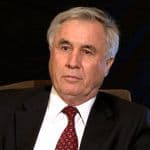
Interviews with Álvaro Varela Walker
Chile
Early Involvement In Politics
“The truth is that I liked to participate in social movements since I was very young.”
Transcript
Since I was very young, I have been very interested in participating in social movements.
In high school I established and was elected president of the Students’ Center. Later, I went on to study law at the University of Chile in 1969.
There I became involved in politics and in 1971, I joined one of the movements that supported Salvador Allende’s government.
[Salvador Allende (1908-1973) was president of Chile between 1970 and1973.]
In 1972 I was elected President of the Law Center, the law student center of the University of Chile. And that was where I was during the period when the coup d’état occurred in Chile in September of 1973.
Immediately after the coup d’état I was expelled from the university. It was done in such a way that it was impossible to continue my studies at any other university under the military regime.
So, under those circumstances, plus the fact that since the beginning of the coup d’état on September 11, 1973, I learned personally of many people (my friends, people with whom I had worked in politics) that began to suffer the consequences of repression.
It was then that, at the beginning of 1974, I became interested in joining the advocacy activities that the Catholic Church, along with the rest of the churches, had begun.
So I joined [the movement], as a law school alumnus who had knowledge of the law and that could contribute as such. In April 1974 I approached the Catholic Church and signed up to work in the defense of human rights in what was then the called the Cooperative Committee for Peace in Chile.
About Álvaro Varela Walker
Álvaro Varela Walker is a Chilean attorney and human rights activist. He was born in 1951.
Varela studied law at the University of Chile. He became student body president and was active in politics. He supported Salvador Allende, a leftist who was elected president of Chile in 1970. In 1973, Allende’s government was overthrown by a military coup led by General Augusto Pinochet. As the universities in Chile came under control of Pinochet’s military regime, he was expelled.
In 1974, he began working as an attorney for the Committee for Cooperation for Peace, an ecumenical initiative of the Catholic Church to catalog and defend against human rights abuses committed by the dictatorship. In 1976, Pope Paul VI established the Vicariate of Solidarity (La Vicaría de la Solidaridad) under the leadership of the Archdiocese of Santiago, where Varela continued his human rights work. In addition to publicly denouncing the human rights abuses of the regime, the Vicariate provided legal assistance to 250,000 Chileans and became a target of the military government.
After the restoration of democracy in 1989, Varela served as a member of the Valech Commission (the National Commission on Political Imprisonment and Torture Report) chaired by Catholic Bishop Sergio Valech, which investigated the human rights record of the Pinochet regime. The Commission found that there were more than 38,000 people detained by the regime. The Valech Commission built on the work of an earlier Rettig Report, which had determined that more than 2,200 people were executed by the Pinochet regime. The Valech Commission provided an accounting of the abuses of the military regime, as well as determining reparations to its victims.