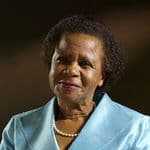
Interviews with Mamphela Ramphele
South Africa
Signs of Inequality
“Why would a person's education be interrupted because they refused to wave a flag?”
Transcript
When my sister was expelled from Emmarentia High School it was in 1961 when we were supposed to be celebrating South Africa becoming a republic.
But it wasn´t a republic for us. As black people but we were given these little flags to wave at our primary school and we were innocent. We didn´t know what they meant or what they were about. So when my sister arrived home unannounced and she said it´s because they refused to do what we did as primary school children. And again, a big question what is this about? Why would a person´s education be interrupted because they refused to wave a flag? It seemed so unreasonable for me as a child but then, of course, later on you get to understand.
But that´s how the system of oppression works that when you dominate a people you actually force them and humiliate them and that´s a way to keep them under oppression.
[In 1961, white South Africans voted in a referendum to end the country’s status as a British dominion and adopt a republican form of government.]
About Mamphela Ramphele
Mamphela Ramphele was born in South Africa’s Limpopo province. She has been an anti-apartheid activist, a medical doctor, a community development activist, a researcher, a university executive, and a global public servant.
As a medical student, Ramphele became one of the founders of the Black Consciousness Movement with activist Steve Biko. They began the movement as a way to empower black South Africans and protest against the apartheid regime.
Following the 1976 Soweto uprising, a series of protests begun by South African high school students, Ramphele was detained without trial. She was released after five months and soon afterwards was legally banned, an apartheid-era mandate where individuals were prohibited from communicating with more than one person at a time and from traveling domestically or internationally without permission.
After the fall of apartheid, Ramphele was appointed Vice-Chancellor of the University of Cape Town becoming the first black woman to hold such a position at a South African university.
From 2000 – 2004, Ramphele served as a Managing Director of the World Bank. She was the first South African to hold the position. Ramphele is a trustee of the Nelson Mandela Children’s Fund, and has served as the director of the Institute for a Democratic Alternative for South Africa.
Ramphele is the author of several books and publications on socio-economic issues in South Africa. She has received numerous national and international awards acknowledging her scholarship and leading role in spearheading projects for disadvantaged people in South Africa.