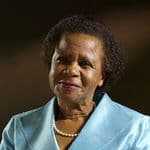
Interviews with Mamphela Ramphele
South Africa
Inspiration
Mamphela discusses inspirations for the Black Consciousness Movement.
Transcript
It´s very interesting because at that time South Africa was a very closed society but we were fortunate to have Charles Sibisi whose parents were teaching at the university. So he got material out of the university library. That helped us to catch up. And he used to listen to BBC. [Charles Sibisi was an anti-apartheid student activists who served in the leadership of the South African Students’ Organization, a national Black students’ group opposed to the apartheid government.]
We didn’t have access to television at the time so he was our international gatherer of information. So we were very much inspired by the student movement internationally. We were inspired by the black power movement in the United States. We were inspired by Martin Luther King. We´re inspired by Malcolm X so we drew on all of those but we also were inspired by Frantz Fanon whose writings spoke to this issue of psychology color oppression. That if you allow yourself to be imprisoned, to be oppressed, you are in a sense acquiescing to your oppression. He encouraged our thinking about identity politics and the importance of a mind that is free even though you live in an unfree society.
[Rev. Martin Luther King, Jr. (1929 – 1968) was an American clergyman and civil rights leader. King used nonviolent civil disobedience to press for civil rights for African-Americans. Malcolm X (1925 – 1965) was an African-American leader and prominent figure in the Nation of Islam who articulated concepts of racial pride and Black Nationalism in the 1950s and ´60s. Frantz Fanon (1925 – 1961) was a Martinique-born Afro-French writer and psychiatrist known for his controversial anticolonial scholarship. His works inspired postcolonial and Black liberation movements around the world.]
We also were inspired by the Negritude Movement with people, particularly in the West Indies who were writing about the Negritude Movement. The importance of black people or people of African descent who are scattered around the world to reimagine themselves and to capture the heritage that they represent because that is what is needed to make the world a better place.
[Negritude was a literary and ideological movement of the 1930s-1950s that began among French-speaking African and Caribbean writers. It rejected European colonization and emphasized black pride and traditional African values.]
About Mamphela Ramphele
Mamphela Ramphele was born in South Africa’s Limpopo province. She has been an anti-apartheid activist, a medical doctor, a community development activist, a researcher, a university executive, and a global public servant.
As a medical student, Ramphele became one of the founders of the Black Consciousness Movement with activist Steve Biko. They began the movement as a way to empower black South Africans and protest against the apartheid regime.
Following the 1976 Soweto uprising, a series of protests begun by South African high school students, Ramphele was detained without trial. She was released after five months and soon afterwards was legally banned, an apartheid-era mandate where individuals were prohibited from communicating with more than one person at a time and from traveling domestically or internationally without permission.
After the fall of apartheid, Ramphele was appointed Vice-Chancellor of the University of Cape Town becoming the first black woman to hold such a position at a South African university.
From 2000 – 2004, Ramphele served as a Managing Director of the World Bank. She was the first South African to hold the position. Ramphele is a trustee of the Nelson Mandela Children’s Fund, and has served as the director of the Institute for a Democratic Alternative for South Africa.
Ramphele is the author of several books and publications on socio-economic issues in South Africa. She has received numerous national and international awards acknowledging her scholarship and leading role in spearheading projects for disadvantaged people in South Africa.