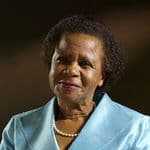
Interviews with Mamphela Ramphele
South Africa
Background
Mamphela discusses her first realization that something was wrong in South Africa.
Transcript
I was born and bred in the northern part of South Africa in the province of Limpopo. I am a product of two teachers and child number three out of seven. I grew up in a rural village where both my parents were teachers. A little village called Kranspoort on the foot of the Soutpansberg Mountains. The Soutpansberg Mountains form the boundary between South Africa and Zimbabwe. It was an idyllic childhood and very rich environment with fruits and vegetables right through there. The most important part of my upbringing is that my parents made it very clear to me – that education, education, education. And not just any education, excellence in education is the foundation for everything. And that was the best gift they could have given me.
The advantage of living in a remote, rural area is that those things [South Africa’s apartheid policies] were not in your face. But there were puzzling things for me, why did we have a dominee or a pastor of our church who was so rude to people he was working with? Who didn´t seem to respect people he should be respecting. Why was he living in this palatial home and ordinary people were living in much poorer circumstances.
The most important events that really shook my innocent childhood was a clash between this pastor and the people of Kranspoort over the rights to bury an old woman who had died. And that sparked a revolt, which divided the community and in the end that village was declared a white spot, a black spot in a white area. And so people were removed en masse and literally scattered around the country. [“Dominee” is an Afrikaans word for a minister.]
Many left the furniture in their homes and that furniture was just destroyed by the elements. It was the most painful and puzzling experience because I was just a grade three student at that time. I didn´t understand what was going on but I could see something serious is happening. And my father then sent us to his home village in Bochum, which was something like 60 kilometers from where we were growing up. And so we were protected from the police raids and the real horrible things that happened there.
It´s only when I became an American student and met with people who came from urban areas where they were aware of the defiance campaign, they were aware of the past law protests that I could flashback and say oh, that is why this was happening. So the idyllic childhood is idyllic because it was ignorance. We were growing up in an environment where we didn´t have the information to understand our environment.
About Mamphela Ramphele
Mamphela Ramphele was born in South Africa’s Limpopo province. She has been an anti-apartheid activist, a medical doctor, a community development activist, a researcher, a university executive, and a global public servant.
As a medical student, Ramphele became one of the founders of the Black Consciousness Movement with activist Steve Biko. They began the movement as a way to empower black South Africans and protest against the apartheid regime.
Following the 1976 Soweto uprising, a series of protests begun by South African high school students, Ramphele was detained without trial. She was released after five months and soon afterwards was legally banned, an apartheid-era mandate where individuals were prohibited from communicating with more than one person at a time and from traveling domestically or internationally without permission.
After the fall of apartheid, Ramphele was appointed Vice-Chancellor of the University of Cape Town becoming the first black woman to hold such a position at a South African university.
From 2000 – 2004, Ramphele served as a Managing Director of the World Bank. She was the first South African to hold the position. Ramphele is a trustee of the Nelson Mandela Children’s Fund, and has served as the director of the Institute for a Democratic Alternative for South Africa.
Ramphele is the author of several books and publications on socio-economic issues in South Africa. She has received numerous national and international awards acknowledging her scholarship and leading role in spearheading projects for disadvantaged people in South Africa.