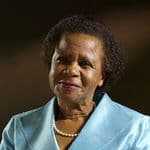
Interviews with Mamphela Ramphele
South Africa
Lessons Learned from South Africa
“Mandela’s leadership welded together segments of society.”
Transcript
I believe that the great successes is the power of the inspirational leadership of Mr. [Nelson] Mandela that welded together segments of our society that people didn’t think was possible.
People didn´t think it would be possible for us to agree to a settlement. To agree to a constitution equal to none in the world, or second to none in the world. …Agree to a process of reconciling people who were on different sides of the freedom struggle. But importantly, people didn´t believe that we could live side by side as South Africans without wanting to gouge each other´s eyes out.
[Nelson Mandela (1918 – 2013) was a South African anti-apartheid revolutionary and politician who served as the first post-apartheid President of South Africa from 1994-1999.]
And that, I think, is a tribute to Mr. Mandela, but not just him, all of the people of his generation truly believed in non-racialism… truly believed in a non-ethnic environment. Truly believed in being servant leaders and so they dedicated themselves and so that´s a big plus. The other big plus is we have a set of very good policies in this country. We cleaned up our macro-economic framework, we committed ourselves to reconstruction and development program, which was intended to live the values of our constitution of making sure everybody lives in dignity, everybody lives with a sense of being equal to anybody else and that there will be freedom not just political freedom but economic freedom, social freedom that´s the theory.
The biggest failure of the last 20 years is our inability to understand the complexity of translating dreams into lived reality. We underestimated what it would take to convert people who are subjects of authoritarian systems. People who were subjects of regimes that said they´re superior or inferior to become equal citizens, active citizens of a society. So what happened in 1994 many of us even those who are active in the struggle handed over their power as citizens to the government particularly because it was the government of Mandela. He’s a saint. Do as you please.
Unfortunately, with Mandela moving out of government, his successors didn´t have the servant leadership approach that he had. His successors were not as committed as he was to reconciling the society.
About Mamphela Ramphele
Mamphela Ramphele was born in South Africa’s Limpopo province. She has been an anti-apartheid activist, a medical doctor, a community development activist, a researcher, a university executive, and a global public servant.
As a medical student, Ramphele became one of the founders of the Black Consciousness Movement with activist Steve Biko. They began the movement as a way to empower black South Africans and protest against the apartheid regime.
Following the 1976 Soweto uprising, a series of protests begun by South African high school students, Ramphele was detained without trial. She was released after five months and soon afterwards was legally banned, an apartheid-era mandate where individuals were prohibited from communicating with more than one person at a time and from traveling domestically or internationally without permission.
After the fall of apartheid, Ramphele was appointed Vice-Chancellor of the University of Cape Town becoming the first black woman to hold such a position at a South African university.
From 2000 – 2004, Ramphele served as a Managing Director of the World Bank. She was the first South African to hold the position. Ramphele is a trustee of the Nelson Mandela Children’s Fund, and has served as the director of the Institute for a Democratic Alternative for South Africa.
Ramphele is the author of several books and publications on socio-economic issues in South Africa. She has received numerous national and international awards acknowledging her scholarship and leading role in spearheading projects for disadvantaged people in South Africa.