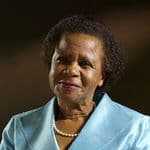
Interviews with Mamphela Ramphele
South Africa
Censorship
“My crime was daring to have books that the apartheid government deemed unhealthy for a native's mind.”
Transcript
We got books, documents through friends who were coming in and out of the country. And because I was a medical doctor at the Livingston Hospital before that arrest [in 1974 for having banned literature] I kept the box with the documents and the books safely because Steve [Biko] could not keep it, because his house could be raided anytime. And unfortunately, I left the hospital being unwell, so I didn´t pack my own luggage. So I would have found a different way of handling them.
So my crime was daring to have books that the apartheid government deemed to be unhealthy for a native´s mind to read. And imagine equating reading a book by let´s say Malcolm X as becoming a communist or being a communist. Or a book by – there were no communist, there wasn´t communist literature in my possession it was just literature about liberation. Liberation was regarded as communist inspired.
[Stephen Bantu Biko (1946 – 1977) was an anti-apartheid activist and the leader of South Africa’s Black Consciousness Movement. He died in 1977, from injuries sustained while in police custody. Malcolm X (1925 – 1965) was an African-American leader and prominent figure in the Nation of Islam who articulated concepts of racial pride and Black Nationalism in the 1950s and ´60s.]
About Mamphela Ramphele
Mamphela Ramphele was born in South Africa’s Limpopo province. She has been an anti-apartheid activist, a medical doctor, a community development activist, a researcher, a university executive, and a global public servant.
As a medical student, Ramphele became one of the founders of the Black Consciousness Movement with activist Steve Biko. They began the movement as a way to empower black South Africans and protest against the apartheid regime.
Following the 1976 Soweto uprising, a series of protests begun by South African high school students, Ramphele was detained without trial. She was released after five months and soon afterwards was legally banned, an apartheid-era mandate where individuals were prohibited from communicating with more than one person at a time and from traveling domestically or internationally without permission.
After the fall of apartheid, Ramphele was appointed Vice-Chancellor of the University of Cape Town becoming the first black woman to hold such a position at a South African university.
From 2000 – 2004, Ramphele served as a Managing Director of the World Bank. She was the first South African to hold the position. Ramphele is a trustee of the Nelson Mandela Children’s Fund, and has served as the director of the Institute for a Democratic Alternative for South Africa.
Ramphele is the author of several books and publications on socio-economic issues in South Africa. She has received numerous national and international awards acknowledging her scholarship and leading role in spearheading projects for disadvantaged people in South Africa.