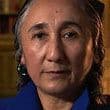
Interviews with Rebiya Kadeer
China · Interviewed January 8, 2010
Uyghurs and the World
Describing the effort of the Uyghur movement to build international support.
Transcript
The strategy of the Uyghur national movement is that Uyghurs must act peacefully with pen, paper, and voice. We must act peacefully and lead our people in a peaceful movement although the Chinese government is using cruelty and suppressing us. We need to have the world understand the brutal oppression Uyghurs are facing and how they are losing their national identity, how they have no rights of any kind, how they have no way of protecting themselves, how they have no freedom of speech, no freedom of expression, basically no freedom of any kind.
The whole world must know us. The world should know such an occupied nation pursuing a movement justly. After that we want the western countries to get involved and recognize it as international affairs instead of saying that it is internal affairs of China. The Uyghurs’ freedom movement, the Uyghurs’ human rights movement must be recognized as a world related issue.
As a result, we are trying to gain international support. Some of the countries that are already helping us are the United States of America, Europe, the European Parliament, the United Nations, England, France, Australia, and Japan. All the democratic countries are helping us. The dictatorships and dictatorship groups are against our movement.
Although we just recently started to lobby for our cause, we are still getting help. This is our strategic plan. We need to pursue this cause. Our plan is to get the whole world involved with Uyghurs’ human rights and Uyghurs’ freedom.
About Rebiya Kadeer
Rebiya Kadeer is a human rights defender, a former prisoner of conscience, and a leader of the Uyghur people. The Uyghurs are Turkic Muslims from China’s Xinjiang Autonomous Region, which most Uyghurs call by its former name, East Turkistan.
Born into a poor family, Kadeer became the owner of a small business and eventually one of the richest people in China. She was appointed to a number of prominent positions by the Beijing government and thought that as an insider she could safely call the government’s attention to human rights violations against her fellow Uyghurs. But she was soon removed from these positions and was arrested and imprisoned in 1999 after attempting to meet with a visiting U.S. delegation from the Library of Congress.
When she refused to renounce her human rights advocacy, the government began arresting her children, several of whom are still in detention.
Released in 2005 on the eve of a visit to China by then Secretary of State Condoleezza Rice, Kadeer now lives in the United States. She serves as president of the Uyghur-American Association and the World Uyghur Congress and continues to speak out for freedom and democracy.