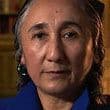
Interviews with Rebiya Kadeer
China · Interviewed January 8, 2010
Religious Persecution
On the lack of religious freedom for Uyghurs.
Transcript
We are 20 million Muslim people. The Chinese burn our Qur’ans, do not allow us to fast during Ramadan, try to put alcohol and pork next to the offices and doors of those Muslims who are employed. And if they do not drink or eat pork, they say that they are not Communists and fire them from their jobs. They are restricting people under 18 years old to attend the mosques.
The ones who are educating the children with religious classes, the ones who are forming religious schools are being arrested, and some of them are even being executed by the Chinese government. Thousands of religious scholars were sent to Egypt, Pakistan, and Saudi Arabia originally by the Chinese government. And when they returned, the government arrested them all.
Thousands of religious scholars are in the jails currently. Some of them are facing executions. There are over 2,000 mosques in our homeland today, but the religious people who are serving there are all being hired by the Communist government. The Islamic world and the Western world are helping us. The Islamic world believes the Chinese lies and propaganda. Therefore, I would like the Islamic world to know that the Chinese government is labeling us as terrorists and restricting our faith, arresting us and killing us because of our faith, and to understand our current situation.
We have not been able to explain our situation to them until today because their relationships are very close with the Chinese government. Therefore I would like the Islamic world to also support us, as do the Western world and Turkey.
About Rebiya Kadeer
Rebiya Kadeer is a human rights defender, a former prisoner of conscience, and a leader of the Uyghur people. The Uyghurs are Turkic Muslims from China’s Xinjiang Autonomous Region, which most Uyghurs call by its former name, East Turkistan.
Born into a poor family, Kadeer became the owner of a small business and eventually one of the richest people in China. She was appointed to a number of prominent positions by the Beijing government and thought that as an insider she could safely call the government’s attention to human rights violations against her fellow Uyghurs. But she was soon removed from these positions and was arrested and imprisoned in 1999 after attempting to meet with a visiting U.S. delegation from the Library of Congress.
When she refused to renounce her human rights advocacy, the government began arresting her children, several of whom are still in detention.
Released in 2005 on the eve of a visit to China by then Secretary of State Condoleezza Rice, Kadeer now lives in the United States. She serves as president of the Uyghur-American Association and the World Uyghur Congress and continues to speak out for freedom and democracy.