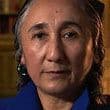
Interviews with Rebiya Kadeer
China · Interviewed January 8, 2010
U.S. Support
Emphasizing the importance of support in the United States for the Uyghur people.
Transcript
The American government rescued Rebiya Kadeer from the Chinese jail. I am alive and I am in the U.S. and I became a voice of my people. This is the first help by the U.S. government. Secondly, it allowed us to continue our Uyghur democratic and freedom movements peacefully and sponsored us financially so that we can lead the people.
It formed Radio Free Asia for us, as we did not have a free voice. Everybody in the world has voices, but the Uyghurs’ voice was gone. Uyghurs were living without knowing what was going on in the outside world. After the Radio Free Asia program aired, although many Uyghurs were being incarcerated for listening to the radio, Uyghurs understood that there is a different political system in the world, the Western democracy and freedom.
Subsequently, after this tremendous help by the U.S. government, American Congressmen and Senators, such as Mr. Tom Lantos, Mr. Hans [Hogrefe], Mr. Frank Wolf, Mr. [Christopher] Smith, Mr. [Bill] Delahunt, etc., many Congressmen and Senators released press statements each and every time when the Chinese government cracked down on the Uyghurs and executed them and made them carry out severe sentences. A few times, these Americans introduced resolutions about the Uyghurs.
This is all the help that is being extended to the Uyghurs. For example, no matter if it was the [U.S.] State Department or the American Congress China specialists, they always reminded the Chinese government in their annual country report. Each year they brought up the issues that Uyghurs are facing. Following the U.S. actions, the European Parliament and the United Nations started to address Uyghur issues in their reports as well, although they had not brought up the Uyghur issues with China in the past. Currently, the Uyghurs are attending the human rights sessions and speaking in front of the [UN] General Assembly, and they are addressing the Uyghur issues.
Eventually, the United Nations started to get involved with our cause. Last time when China cracked down against the Uyghurs, 140 members of the European Parliament signed a statement condemning the Chinese government’s brutal actions against the Uyghurs. When the Chinese government branded the World Uyghur Congress as terrorists and separatists, the European Parliament released statements and said that Rebiya Kadeer is not that kind of person and that they supported their peaceful movements.
At the same time, when they had dialogues with the Chinese government, they brought up the Uyghur issue with them. The Chinese government also realized that the Uyghur movement is becoming an international issue. Uyghurs also understood that the international community is being involved in their democratic movements and started to learn how to address their cause.
Wait, I want to say one more thing, hold on. Wait. I want to say something here at the end. First of all, I want to thank Mr. President Bush. Many places I have been questioned about President Bush. But in my heart, Mr. President Bush, his wife and his family have the most important position when it comes to the Uyghur people’s global recognition. Therefore, 20 million Uyghur people are grateful for President Bush and his era.
About Rebiya Kadeer
Rebiya Kadeer is a human rights defender, a former prisoner of conscience, and a leader of the Uyghur people. The Uyghurs are Turkic Muslims from China’s Xinjiang Autonomous Region, which most Uyghurs call by its former name, East Turkistan.
Born into a poor family, Kadeer became the owner of a small business and eventually one of the richest people in China. She was appointed to a number of prominent positions by the Beijing government and thought that as an insider she could safely call the government’s attention to human rights violations against her fellow Uyghurs. But she was soon removed from these positions and was arrested and imprisoned in 1999 after attempting to meet with a visiting U.S. delegation from the Library of Congress.
When she refused to renounce her human rights advocacy, the government began arresting her children, several of whom are still in detention.
Released in 2005 on the eve of a visit to China by then Secretary of State Condoleezza Rice, Kadeer now lives in the United States. She serves as president of the Uyghur-American Association and the World Uyghur Congress and continues to speak out for freedom and democracy.