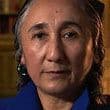
Interviews with Rebiya Kadeer
China · Interviewed January 8, 2010
Family
On the high price her family has paid for her leadership of the Uyghur movement.
Transcript
It is worth it if I can make the voice for the freedom of that nation and the voice of the suffering of that nation heard by the world. Let me use my family as an example: my husband Sidiq Haji had been in prison for nine years. I was in prison for six years. My two sons: one is sentenced to nine years and the other one is sentenced to seven years because of my activities.
Three of my children are under surveillance. Seven of my grandkids have been expelled from school. The Chinese government even took my children’s house and kicked them out of their house. After the July 5th [2009 Ürümqi] event, just like back in the Cultural Revolution, they used my children to insult me on the TV and newspapers. The police brought out one of my sons from prison and made him humiliate me and insult me. You can find this video on YouTube.
They made my daughters and 13-year-old grandkids insult me. I am aware of how much emotional shock they will suffer from this. But this is not just my family’s problem. This is an issue for every Uyghur family that lives in East Turkistan. I think it is not morally correct for me to rescue my own family and to make them live happy but to watch my people suffer. Not only for me; I think this is a basic moral for a human being.
About Rebiya Kadeer
Rebiya Kadeer is a human rights defender, a former prisoner of conscience, and a leader of the Uyghur people. The Uyghurs are Turkic Muslims from China’s Xinjiang Autonomous Region, which most Uyghurs call by its former name, East Turkistan.
Born into a poor family, Kadeer became the owner of a small business and eventually one of the richest people in China. She was appointed to a number of prominent positions by the Beijing government and thought that as an insider she could safely call the government’s attention to human rights violations against her fellow Uyghurs. But she was soon removed from these positions and was arrested and imprisoned in 1999 after attempting to meet with a visiting U.S. delegation from the Library of Congress.
When she refused to renounce her human rights advocacy, the government began arresting her children, several of whom are still in detention.
Released in 2005 on the eve of a visit to China by then Secretary of State Condoleezza Rice, Kadeer now lives in the United States. She serves as president of the Uyghur-American Association and the World Uyghur Congress and continues to speak out for freedom and democracy.